SpaceX Dragon Docks at Space Station with New Science
A SpaceX Cargo Dragon spacecraft has arrived at the space station, delivering new solar wings, brain models, and medical tools to help restore eyesight.
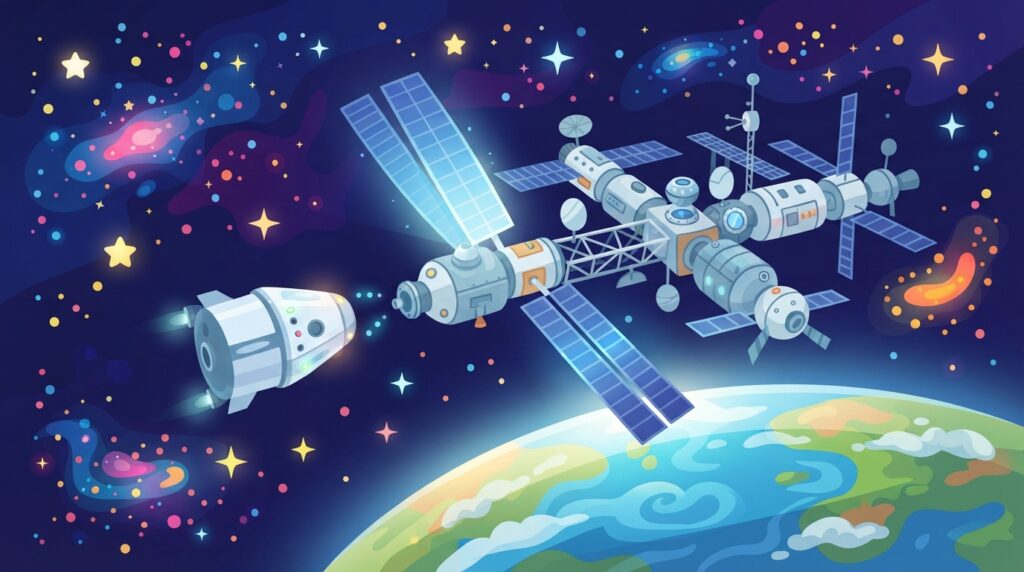
Imagine receiving a massive delivery parcel straight from outer space! On 15 October 2026, an uncrewed cargo craft completed its journey as the SpaceX Dragon space station mission safely linked up with the orbiting laboratory high above Earth. Floating around our planet in low Earth orbit, the spacecraft attached itself to the space-facing port of the Harmony module at 10:27 a.m. EDT (14:27 UTC).
This special voyage, officially called CRS-35, is the 35th commercial resupply services mission flown by SpaceX under contract with NASA. The capsule brought thousands of kilograms of gear, exciting medical experiments, and giant solar wings to keep the space station powered and bustling with discovery.
What happened?
The thrilling adventure began on Tuesday, 13 October 2026, when a Falcon 9 rocket soared into the morning sky at 6:33 a.m. EDT from Space Launch Complex 40 at Cape Canaveral Space Force Station in Florida. The rocket’s first-stage booster, named B1096, completed its eighth successful flight and landed safely back at Landing Zone 40 minutes after liftoff. Meanwhile, the Cargo Dragon vehicle, numbered C211, sped onward to space on its fourth orbital journey, having previously flown on NASA’s CRS-26, CRS-29, and CRS-33 missions.
In total, the Dragon capsule transported 6,322 pounds (2,868 kilograms) of cargo. Inside the pressurized section were 3,687 pounds of science equipment and crew supplies, while 2,635 pounds of hardware travelled in the spacecraft’s trunk. On 16 October 2026, the astronauts of the Expedition 75 crew opened the hatches to begin unloading the supplies and switching on the new investigations.
Stowed inside the capsule’s trunk is the final set of International Space Station Roll-Out Solar Arrays, known as IROSA. These clever solar wings unfurl like giant carpets to capture sunlight and expand the orbital laboratory’s electrical power.
Even more fascinating are the medical investigations sent to the station. Scientists packed specialized equipment designed to manufacture artificial retinas in weightlessness, which could help doctors restore sight to people suffering from vision loss back on Earth. The flight also carried miniature 3D brain models and living heart tissue constructs to explore how microgravity affects human cells, along with ingredients to make ultra-pure specialty glass that can only form without gravity-driven distortions.
Why does it matter to you?
When you gaze up at the stars from your balcony or school ground in India, space can seem completely disconnected from our daily routines. Yet, the work happening on the space station directly helps people in our own neighbourhoods and towns.
Many people in our communities suffer from eye illnesses or conditions affecting the heart and brain. Because objects float weightlessly in orbit, tiny cells and artificial body parts can grow cleanly without being squished down by gravity. That means the tests happening inside this spacecraft could help researchers invent life-changing medical treatments and hospital tools that benefit patients all over the world, including right here in India.
Words to know
- Microgravity: A state of almost complete weightlessness where things float freely because gravity is barely felt.
- Retina: The thin layer at the very back of the eye that senses light and sends images to your brain so you can see.
- Solar array: A large collection of solar panels that absorb light from the Sun and turn it into electricity.
- Payload: The total amount of cargo, tools, and scientific equipment carried on board a spacecraft or rocket.
Did you know?
The Cargo Dragon capsule used for this mission is a true space veteran, having completed three earlier round trips to orbit on the CRS-26, CRS-29, and CRS-33 missions before launching on this flight!
Think about it
If you could design a science experiment to send to the International Space Station, what kind of problem would you try to cure? How do you think floating without gravity would help your experiment succeed?
Quick quiz
What medical equipment was sent aboard the Dragon capsule to help restore sight to people with vision loss?
- Artificial retinas
- Special contact lenses
- Electronic magnifying glasses
See the answer
Artificial retinas
Sources
This story was prepared by the Kids Gazette news desk with the help of AI research and writing tools, using the sources listed above.