
Giant Balloon Telescope Finds Secret Web on the Sun
A giant balloon telescope flying high above Earth has revealed a hidden, thread-like magnetic web above calm regions of the Sun.
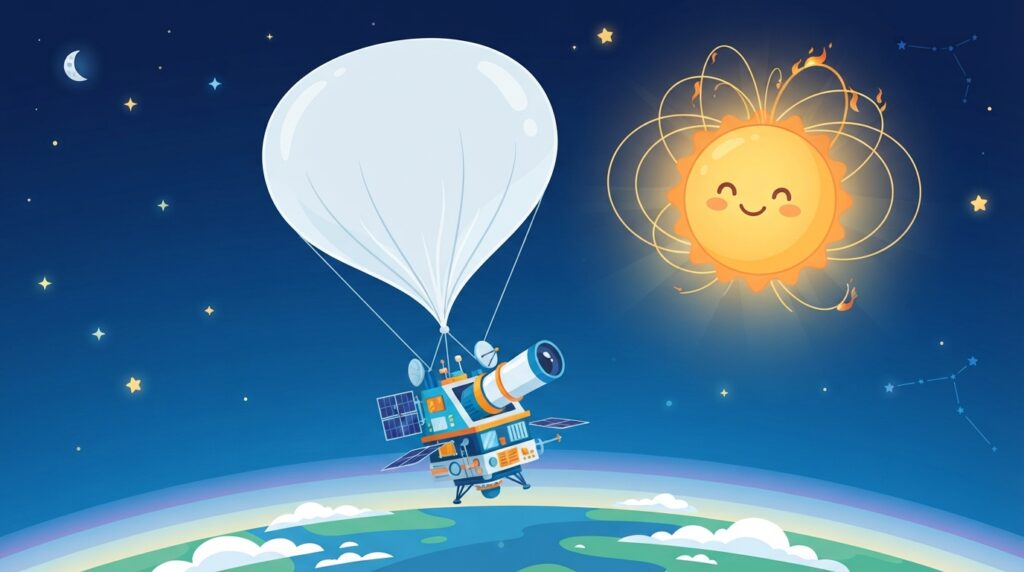
Imagine soaring high into the sky on a giant white balloon, far above the clouds, to take pictures of our nearest star! On 24 October 2026, an international team of scientists led by the National Astronomical Observatory of Japan shared some dazzling news from Mitaka, Japan. They revealed that their floating observatory had spotted a hidden, thread-like magnetic web above calm areas of the Sun. This exciting balloon telescope sun discovery is helping scientists solve big mysteries about how our solar neighbourhood works.
The special mission, called Sunrise-III, carried a powerful one-metre telescope high into Earth’s stratosphere. Flying approximately 35 kilometres above our planet, this high-altitude craft captured crisp, clear pictures of solar features. Up there, it was completely free from the thick, tumbling air near the ground that usually blurs fine details for Earth-based astronomers.
What happened?
Looking at the Sun from Earth is tricky because our moving atmosphere constantly bends light. By floating in the quiet stratosphere, Sunrise-III escaped this problem completely. The balloon carried a scientific basket called a gondola with three specialised instruments. One key tool was a near-infrared instrument named SCIP, developed under the leadership of Japanese researchers.
SCIP was built to measure the polarization of light, which shows the direction and strength of magnetic forces. This clever method helped astronomers map magnetic fields continuously across different atmospheric layers of the Sun rather than looking at just one level. The instrument observed both the photosphere, which is the Sun’s visible surface, and the chromosphere, the atmospheric layer directly above it.
Before this flight, scientists believed that the magnetic canopy spreading into the chromosphere formed a smooth, uniformly expanding dome. However, the high-resolution images from Sunrise-III showed that this canopy is actually a tangled web of narrow, elongated magnetic threads! Computer simulations showed that twisting motions on the solar surface twist the magnetic field lines to weave these thread-like shapes.
The observatory also measured magnetic fields inside spicules, which are towering, jet-like fountains of solar gas that shoot straight up from the surface. Quiet regions cover most of the Sun and have weaker magnetic fields than stormy sunspot patches, which previously made them very difficult to measure accurately. These new observations provide scientists with fresh clues about how energy travels upward to heat the Sun’s outer layers.
Why does it matter to you?
Every single morning, bright sunshine warms our school playgrounds, homes, and farms across India. Even though the Sun is our closest cosmic neighbour, scientists are still unravelling the secrets of how its fiery atmosphere works.
Learning how magnetic energy travels across the Sun helps us understand the energetic star that powers all life on our planet. This mission also proves that exploring space does not always require giant, roaring rockets. Sometimes, a peaceful balloon ride to the edge of space can unlock brand new wonders!
Words to know
- Stratosphere: the calm layer of Earth’s atmosphere located high above the clouds where weather happens.
- Photosphere: the bright, visible surface layer of the Sun that shines light onto Earth.
- Chromosphere: the dynamic layer of solar atmosphere resting directly above the Sun’s visible surface.
- Spicules: tall, jet-like shoots of solar gas that blast upward from the surface of the Sun.
Did you know?
Quiet areas actually make up most of the Sun’s surface, but their gentle magnetic fields were almost impossible to measure clearly until Sunrise-III floated high above Earth’s blurry atmosphere!
Think about it
Why do you think scientists chose a gentle floating balloon instead of a noisy rocket to study the Sun? If you could send a floating science experiment high into the sky, what cosmic mystery would you want to investigate?
Quick quiz
What carried the Sunrise-III telescope high into Earth’s stratosphere?
- A giant stratospheric balloon
- A roaring chemical rocket
- An orbiting robotic satellite
See the answer
A giant stratospheric balloon
Sources
This story was prepared by the Kids Gazette news desk with the help of AI research and writing tools, using the sources listed above.