
Active Volcanoes on Mars: Giant Mountain Leaks Gas
Scientists have discovered gas leaking from a giant volcano on Mars, showing the Red Planet may still be warm and active inside!
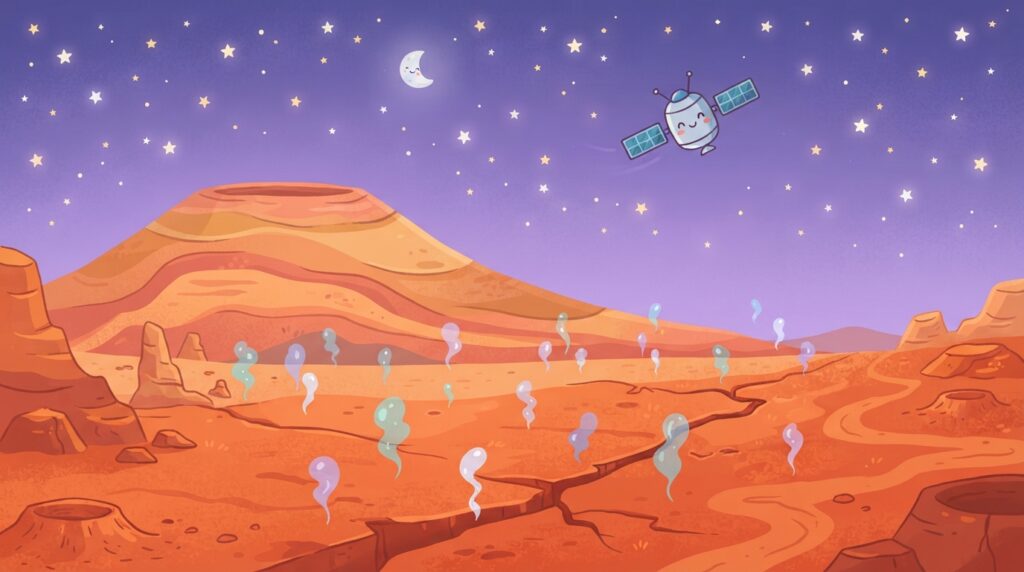
Have you ever thought of Mars as a freezing, silent desert floating in outer space? On 4 November 2026, an international team of scientists published exciting new evidence showing there might be active volcanoes on Mars after all!
A robotic spacecraft orbiting the Red Planet detected mysterious plumes of gas rising into the thin Martian sky. The gas was spotted leaking directly above a colossal mountain named Alba Mons, which is the largest volcano on Mars by surface area.
What happened?
The groundbreaking discovery was announced in a respected scientific journal called Science Advances. The study was co-led by planetary researchers Alexander Trokhimovskiy from the Russian Space Research Institute and Daniel Mège from the Space Research Centre of the Polish Academy of Sciences.
Their clues came from the ExoMars Trace Gas Orbiter, a spacecraft operated by the European Space Agency (ESA). Using sensitive infrared tools called the Atmospheric Chemistry Suite, the spacecraft measured tiny traces of hydrogen chloride gas at parts-per-billion levels. On Earth, hydrogen chloride is a sharp, smelly gas pushed out of active magma systems and volcanic cracks when molten rock rises toward the surface.
The timing of the discovery surprised the team. The gas appeared during the planet’s chilly aphelion season, a time when Martian atmospheric chemistry alone cannot explain why the gas is there. To solve the riddle, researchers studied detailed pictures taken by the orbiter’s CaSSIS camera and NASA’s HiRISE camera. Right beneath the gas clouds, they spotted fresh cracks in the ground! Some of these fissures were less than one metre wide, stretching out in long swarms across tens of kilometres.
For many years, scientists believed Mars was geologically dead. These new findings show that the planet’s interior is simply dormant and still holds enough heat to produce magma. Colin Wilson, a project scientist with ESA, described the exciting finding as potentially the greatest success of the entire spacecraft mission!
Why does it matter to you?
When you look up at the night sky from your balcony or school playground in India, Mars looks like a calm, reddish speck of light. It is thrilling to learn that deep under its dusty plains, our neighbour planet is still buzzing with natural energy!
Even more excitingly, active underground magma can create hydrothermal vents, very similar to the warm vents found under oceans on Earth. These underground spots provide warmth, moisture, and rich minerals. That means they could serve as a cosy shelter for microscopic alien life to survive away from the cold Martian surface! If you dream of joining a space programme like ISRO in the future, these warm rifts might be the exact spots where your rover will hunt for Martian microbes.
Words to know
- Fissure: a long, narrow crack or opening in the ground or in rock.
- Magma: extremely hot, melted liquid rock found deep inside a planet.
- Dormant: temporarily quiet or asleep, but capable of waking up later.
- Hydrothermal vent: an opening beneath the ground that releases hot water, steam, and minerals.
- Aphelion: the point during an orbit when a planet is farthest away from the Sun.
Did you know?
Alba Mons is the largest volcano on Mars by surface area, spreading out so wide that its giant base could cover several Indian states!
Think about it
If tiny living microbes are eventually found hiding in warm cracks beneath the Martian soil, how would that change the way we view our solar system? What kind of rover would you build to explore those deep underground fissures?
Quick quiz
Which gas did scientists detect leaking from the Martian volcano Alba Mons?
- Hydrogen chloride
- Carbon dioxide
- Pure oxygen
See the answer
Hydrogen chloride
Sources
This story was prepared by the Kids Gazette news desk with the help of AI research and writing tools, using the sources listed above.