
New Giant Flowering Plant Discovered in Northeast India
Botanists have found a giant new flowering plant in the forests of Assam and Meghalaya that grows nearly six feet tall with starry white blossoms!
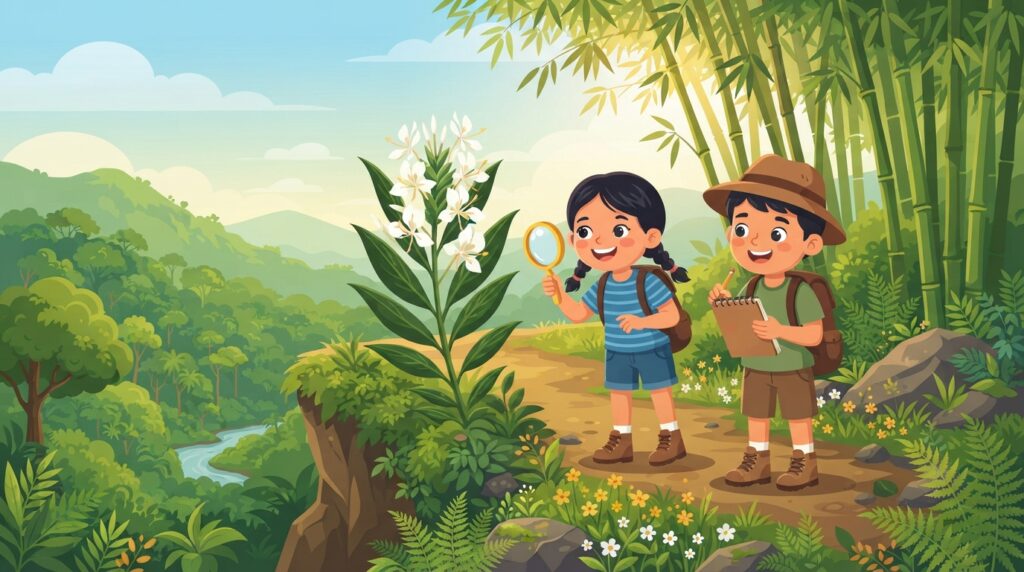
Imagine taking a hike through a quiet jungle and stumbling upon a flower taller than your school teacher! On 5 November 2026, scientists announced that a remarkable new flowering plant discovered in the lush forests of Assam and Meghalaya stands nearly six feet tall. This leafy giant was spotted living quietly across three special spots in Northeast India.
The newly identified plant has been given the scientific name Disporum kamakhasiense. Its special name honours two famous places: “Kamrupa”, which is the ancient historical name for Assam, and the beautiful “Khasi Hills” of Meghalaya. Assam’s Environment and Forests Minister Jayanta Malla Baruah proudly shared news of this green treasure with the world.
What happened?
A dedicated team of botanists discovered the herb while studying the rich plant life of the region. The team included Dixit Bora, Biswajit Paul, and Devanjal Bora from the Central Ayurveda Research Institute in Guwahati. They joined forces with Dipankar Borah from Kaliabor College and Aaron Floden from the Missouri Botanical Garden Herbarium in the United States. Their detailed study was formally published in the botanical journal Novon.
The tall herb belongs to a plant group known as the Colchicaceae family. While many woodland herbs remain small, this perennial plant grows between 120 centimetres and 180 centimetres tall! That makes it far bigger than its closest plant relative, Disporum calcaratum, which usually reaches only up to 100 centimetres in height.
Up close, the plant shows off distinct branched stems and smooth leaves patterned with seven prominent parallel veins. Between June and July, it blooms with delicate white, star-shaped flowers that have straight spurs. Later in the rainy season, between July and August, these starry blossoms develop into fruit.
Researchers observed the plant in only three forest locations: Garbhanga Reserve Forest near Guwahati, Laisong in Assam’s Dima Hasao district, and the Barapani area of Meghalaya. It flourishes in semi-evergreen forests at elevations between 200 and 1,100 metres, clinging to steep cliff edges tucked beneath shady bamboo canopies.
Because its known groups are very small, scientists warned that the plant could be endangered. Its fragile forest homes face serious risks from highway expansion, deforestation, and habitat loss. If these wild places are harmed, this rare botanical wonder could struggle to survive.
Why does it matter to you?
This exciting discovery shows that the wild forests of India are still full of wonderful living secrets. You do not have to travel to outer space to find new mysteries. Amazing treasures are still waiting right here on Planet Earth for keen-eyed young explorers and future scientists to find!
The find also teaches us why preserving undisturbed nature is so important for all of us. When forests are cut down for construction or roads, rare plants that grow nowhere else can vanish forever. Caring for our wild lands ensures that incredible species can bloom safely for generations to come.
Words to know
- botanist: a scientist who studies plants and flowers
- perennial: a plant that lives and grows back year after year
- habitat: the natural home where a plant or animal lives
- canopy: the high, leafy shelter formed by the tops of trees or tall bamboo in a forest
Did you know?
At 180 centimetres tall, this newly found herb can grow as tall as a full-grown adult human, which is unusually large for plants in its family!
Think about it
If you were a botanist walking through a forest, what signs would you look for to tell if a plant is rare? How can communities build useful roads while still keeping safe spaces for delicate wild plants?
Quick quiz
Where was the new flowering plant Disporum kamakhasiense discovered?
- Forests of Assam and Meghalaya
- Deserts of Rajasthan and Gujarat
- Snowy peaks of Himachal Pradesh and Ladakh
See the answer
Forests of Assam and Meghalaya
Sources
This story was prepared by the Kids Gazette news desk with the help of AI research and writing tools, using the sources listed above.