NASA Twin Mars Probes Slingshot Past Earth
NASA's twin ESCAPADE spacecraft, Blue and Gold, have used Earth's gravity as a giant slingshot to speed toward Mars in a historic space manoeuvre.
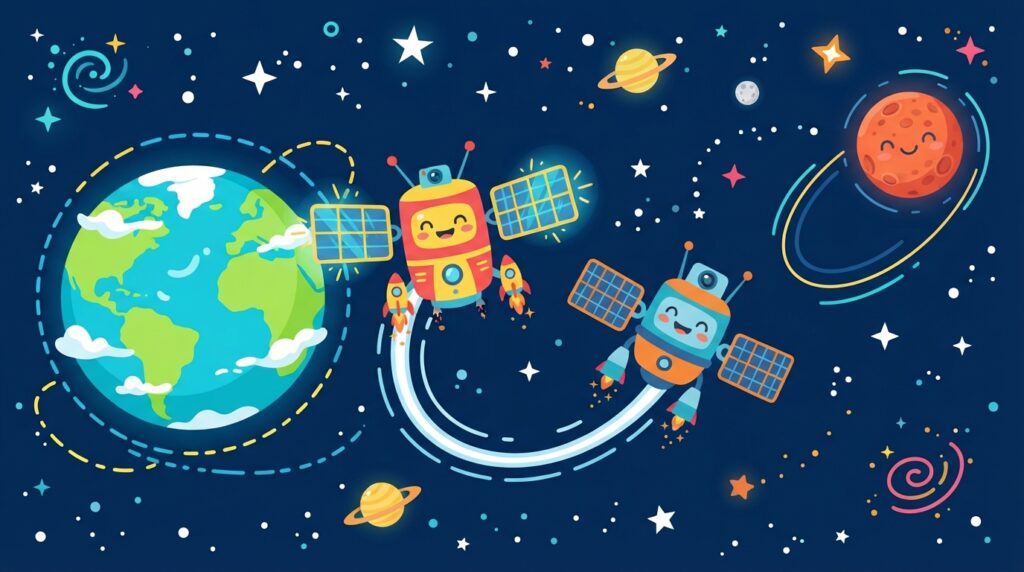
Two robotic explorers have just performed a spectacular, record-breaking manoeuvre high above our heads! On 9 November 2026, mission controllers celebrated as the NASA twin Mars probes, affectionately named Blue and Gold, successfully whipped past Earth. This historic gravity slingshot has put them on a direct, super-fast course toward the mysterious Red Planet.
The exciting journey is part of NASA’s ESCAPADE mission, which stands for Escape and Plasma Acceleration and Dynamics Explorers. Conceived, led, and operated by scientists at the University of California, Berkeley’s Space Sciences Laboratory, the twin satellites were specially designed and built by Rocket Lab.
What happened?
Blue and Gold originally launched into space on 13 November 2025 atop a New Glenn rocket from Cape Canaveral, Florida. However, Earth and Mars were not properly aligned for an immediate journey across the solar system. To solve this cosmic puzzle, clever flight navigators sent the twins into a year-long “loiter” orbit around a spot called Earth-Sun Lagrange point 2 (L2), roughly one million miles away.
After waiting for the planets to line up, the spacecraft swung back towards Earth for a powered gravity assist. Blue made its close approach at 5:00 a.m. EST on Saturday, 7 November 2026, passing approximately 1,000 miles (1,700 kilometres) above Earth. Gold followed soon after, completing its approach at 6:00 a.m. EST on Monday, 9 November 2026, skimming roughly 650 miles (1,046 kilometres) above the surface.
During these close encounters, each probe autonomously fired its onboard thrusters for nine to ten minutes. NASA confirmed that this trans-Mars injection burn was carried out with greater than 99 percent accuracy! The combination of Earth’s gravity and rocket thrust increased each probe’s speed by more than 1,000 miles per hour, pushing them to roughly 6.7 miles per second. This is the first time in space history that a Mars mission has ever used a powered Earth flyby to steer toward Mars.
The spacecraft will now cruise through deep space for 10 months. Blue is scheduled to arrive at Mars on 7 September 2027, followed closely by Gold on 9 September 2027. When they enter orbit, they will become the first twin fleet to fly in formation around Mars, measuring how solar wind strips away atmospheric gases.
Why does it matter to you?
Have you ever spun around on a playground ride and felt a thrilling push? Scientists use that exact same concept in space navigation! By using our own home planet’s gravity to whip spacecraft forward, engineers save massive amounts of rocket fuel on long trips across the solar system.
Studying Mars also helps curious minds in India and across the world understand planetary climates. Mars was once warm and watery, but over billions of years, it transformed into a freezing desert. By observing how space weather strips away Martian air, these robotic twins will unlock secrets that help prepare the way for future human astronauts.
Words to know
- Gravity assist: using a planet’s natural gravitational pull to change a spacecraft’s speed and direction.
- Autonomous: performing tasks independently using onboard computer programmes without real-time human control.
- Solar wind: a continuous stream of energetic particles and gas blown outwards from the Sun.
- Orbit: the curved, repeating path an object takes around a planet, moon, or star.
Did you know?
Blue and Gold spent an entire year waiting in a “loiter” orbit nearly one million miles from Earth just waiting for the perfect cosmic timing to zoom toward Mars!
Think about it
If you were in charge of sending a robotic explorer to another planet, what special scientific tools would you pack to study its weather and rocks?
Quick quiz
What are the nicknames of the twin ESCAPADE spacecraft heading to Mars?
- Red and Green
- Blue and Gold
- Sun and Moon
See the answer
Blue and Gold
Sources
This story was prepared by the Kids Gazette news desk with the help of AI research and writing tools, using the sources listed above.