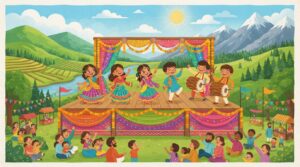
Meghalaya Celebrates Wangala Festival with 1,000 Drums
Meghalaya marked the 50th Golden Jubilee of the Wangala Festival with 1,000 traditional drums, feathered dancers, and ancient harvest rituals.

Imagine feeling the ground tremble as one thousand drums beat together in rhythm! That powerful sound echoed across the green hills of Northeast India during the famous Meghalaya Wangala Festival. Between 11 and 14 November 2026, the Garo community gathered at Wangala A’dam in the Garo Heritage Village at Chibagre, near Tura in West Garo Hills, to mark their grandest post-harvest thanksgiving celebration.
This landmark event was the 50th edition, or Golden Jubilee, of the organised festival that first began back in 1976. While the gathering is famously known as the Hundred Drums festival, organisers expanded the music tenfold this year under the exciting theme “Rhythm of 1,000 Drums”.
What happened?
Wangala is the most prominent post-harvest festival celebrated by the Garo people, who also call themselves the A·chik community. It is held in honour of Misi Saljong, the Sun God of fertility and bountiful harvests, to thank him for nourishing crops. Meghalaya Chief Minister Conrad K. Sangma inaugurated the Golden Jubilee celebrations on 11 November 2026 and even picked up drumsticks to join the musicians.
Sacred ancient traditions were an important part of the programme. A traditional priest known as a Kamal led special ceremonies, including the sacred Rugala offering and the Cha·chat So·a incense-burning ceremony. Soon after, the musical spectacle began as approximately 1,000 drummers beat long wooden drums called dama. Thousands of dancers stepped in unison wearing magnificent feathered headdresses called Do’me. Community leaders and organisers coordinated this massive performance with hopes of entering the Guinness World Records.
Cultural troupes travelled from all across the Garo Hills, as well as neighbouring states such as Assam, Tripura, and Nagaland. On 13 November 2026, Meghalaya Governor Chandrashekhar H. Vijayashankar attended the festival as the chief guest and watched a lively performance by a dedicated Kids’ Wangala Troupe. Visitors also enjoyed indigenous sports, including Wa·pong sika (a traditional tug-of-war played with a bamboo pole) and Rongma De·usaa (a heavy rock lifting contest). An enormous handloom and handicrafts exhibition featuring more than 300 stalls gave local tribal weavers and traditional artisans a platform to show their creations.
Why does it matter to you?
India has a wonderful variety of tribal cultures, and festivals like Wangala help us understand how communities cherish and preserve their unique heritage. Seeing young artists in the Kids’ Wangala Troupe perform on a giant stage reminds us that traditions stay alive when they are passed down from elders to children.
The festival also shows the power of unity and cooperation. Playing one thousand drums at the exact same tempo takes incredible teamwork, patience, and practice. When people work together in harmony, they can create something unforgettable that inspires the entire country.
Words to know
- Dama: A traditional long wooden drum played by the Garo people.
- Do’me: A special feathered headdress worn by Garo dancers during cultural celebrations.
- Kamal: A traditional Garo priest who performs ancient sacred ceremonies and prayers.
- Wa·pong sika: An indigenous Garo sport similar to tug-of-war, played using a strong bamboo pole.
- Golden Jubilee: The celebration of a special 50th anniversary of an event.
Did you know?
The Wangala Festival originally showcased one hundred drums, but for this 50th year milestone, the drummers multiplied by ten to create a group of 1,000 drummers playing together!
Think about it
What kind of harvest or thanksgiving celebrations take place where you live? How do you think drumming together in a group helps people feel more connected?
Quick quiz
What are the traditional wooden long drums played during the Wangala festival called?
- Dama
- Do’me
- Kamal
See the answer
Dama
Sources
This story was prepared by the Kids Gazette news desk with the help of AI research and writing tools, using the sources listed above.