
ISRO SpaDeX Mission: Twin Satellites Return Home
ISRO has completed its historic SpaDeX mission after twin satellites safely re-entered Earth's atmosphere following a 21-month journey in space.
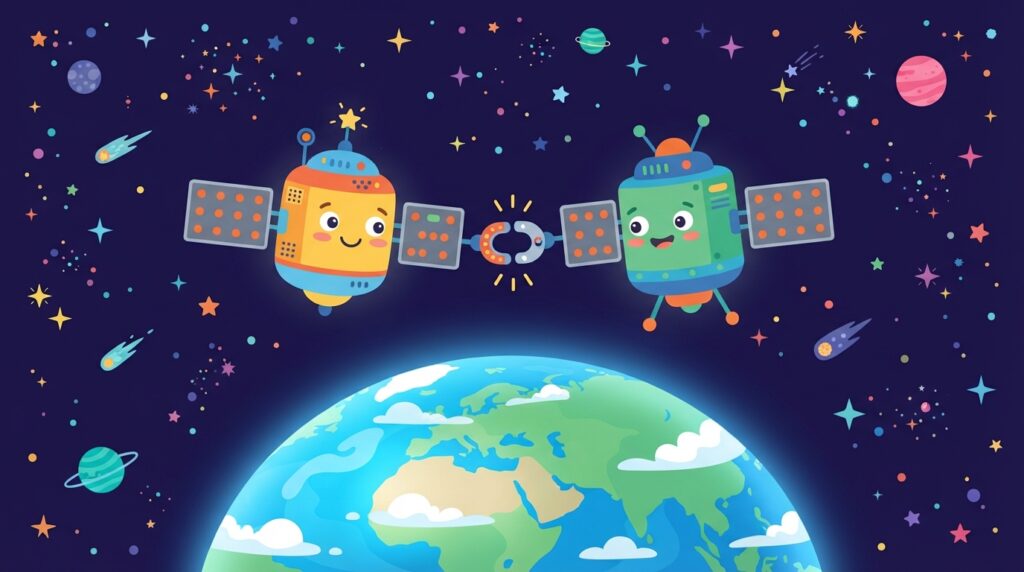
India’s space agency has just wrapped up an incredible cosmic adventure! Scientists at the Indian Space Research Organisation (ISRO) in Bengaluru have confirmed the successful conclusion of the ISRO SpaDeX mission. Over an exciting 21-month operational journey, two small robotic satellites danced, docked, and shared energy high above our planet before returning safely home in October 2026.
The twin spacecraft, named SDX01 and SDX02, completed their final journey by cleanly burning up in the upper atmosphere. Tracking experts from the ISRO Telemetry, Tracking and Command Network (ISTRAC) in Bengaluru and the US Space Force catalogue Space-Track confirmed the re-entry on 18 October 2026, noting that both satellites finished their work without creating long-term orbital debris.
What happened?
The thrilling journey began on 30 December 2024, when a Polar Satellite Launch Vehicle (PSLV-C60) blasted off from Sriharikota carrying both satellites together into orbit. Each spacecraft weighed approximately 220 kilograms, which is about the weight of two large adult pandas! Their main goal was to test space docking, which means bringing two separate flying machines together so smoothly that they lock into a single unit.
On 16 January 2025, ISRO achieved its very first orbital docking between SDX01 (the Chaser) and SDX02 (the Target). This proud milestone made India only the fourth country in the world—after the United States, Russia, and China—to master space docking technology. It proved that Indian spacecraft could steer towards each other in orbit with brilliant accuracy.
The twin satellites had even more tricks up their sleeves. After parting ways on 13 March 2025, they completed a second docking autonomously from a distance of 15 metres on 20 April 2025 without human controls! Just one day later, ISRO demonstrated inter-spacecraft electrical power transfer, using power from one satellite to run a heater on the other.
Over time, the satellites gently descended towards Earth. Their altitude decreased from 460 kilometres to 413 kilometres by 1 January 2026, reached 312 kilometres by 1 September 2026, and dropped to around 155 kilometres on 12 October 2026. SDX01 re-entered the atmosphere at 9:38 pm IST on 12 October over the southern Indian Ocean, west of Australia. About seven hours later, at 4:35 am IST on 13 October, SDX02 made its re-entry over the North Pacific Ocean, south of the Aleutian Islands.
Why does it matter to you?
Think of space docking like connecting building blocks high in the sky while travelling at super speeds! It allows different parts of a spacecraft to connect, share energy, and assemble giant structures above the Earth.
The lessons learned from this mission are paving the way for India’s upcoming Chandrayaan-4 lunar sample-return mission to bring rocks back from the Moon. They are also essential for putting together the planned Bharatiya Antariksh Station, where future Indian astronauts will live and conduct science experiments!
Words to know
- Docking: the delicate process of joining two separate spacecraft together in space.
- Autonomous: acting independently using computer commands and sensors without human help.
- Re-entry: the moment when a spacecraft returns from space and passes back into Earth’s atmosphere.
- Altitude: the height of an object above the ground or sea level.
Did you know?
India is one of only four nations across the entire globe—alongside the United States, Russia, and China—to successfully accomplish a space docking manoeuvre!
Think about it
If you were an astronaut visiting the future Bharatiya Antariksh Station, what kind of science experiments would you want to conduct in orbit? How do you think robotic spacecraft will help humans explore even further into our solar system?
Quick quiz
On what date did ISRO achieve its very first space docking between SDX01 and SDX02?
- 30 December 2024
- 16 January 2025
- 20 April 2025
See the answer
16 January 2025
Sources
This story was prepared by the Kids Gazette news desk with the help of AI research and writing tools, using the sources listed above.