Ghostly Eyeless Cave Snail Found in China
Scientists have found a tiny, ghostly eyeless snail living inside a mountain cave in China, marking an exciting first for science!
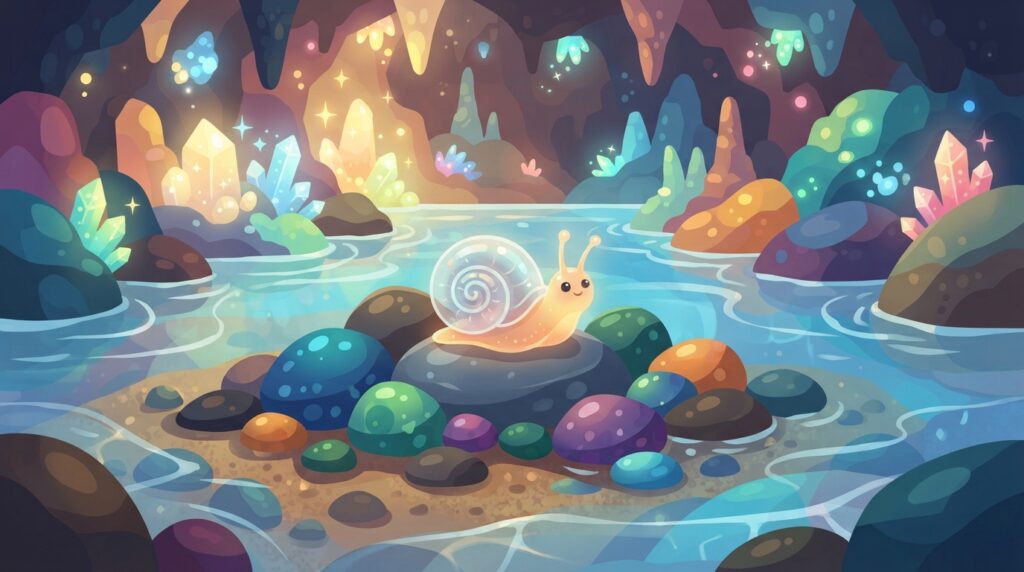
Imagine exploring a quiet, pitch-black mountain cave and spotting a creature so tiny that it could rest on the tip of your pencil. On 21 October 2026, researchers announced the exciting discovery of a rare eyeless cave snail found deep inside an underground stream in China. This remarkable animal is the very first freshwater cave snail ever documented in the country!
The tiny mollusk was discovered in Hongta District, which is in Yuxi City in Yunnan Province, China. An international team of scientists described the unusual snail in a study published in the scientific journal Subterranean Biology.
What happened?
The newly discovered species has been given the scientific name Erhaia dijiang. Researchers named it after Di Jiang, a faceless mythical creature and mountain god described in an ancient Chinese text called the Classic of Mountains and Seas. Just like the mythical character, this tiny cave snail has no eyes at all!
Because the snail has evolved specifically to live in subterranean darkness, scientists call it a troglobiont. Deep inside the cave, there is no sunlight, so the creature does not need bright colour or eyesight. It has a pale, unpigmented body, long slender tentacles to feel its surroundings, and a cone-shaped, translucent shell that measures only about 2.05 millimetres long and 0.98 millimetres wide.
This special snail was found living at an elevation of 2,062 metres (6,765 feet) above sea level. This is the highest altitude ever recorded for any cave-dwelling member of the snail family Erhaiidae. It lives in shallow cave waters less than one metre deep, sheltering among submerged gravel and loose stones where the water temperature stays close to 20 degrees Celsius.
Even though the snail has completely lost its eyes, it still reacts to brightness! When tested in laboratory settings, the snails showed strong sensitivity to illumination and quickly retreated under dark rocks as soon as the lights came on. While being observed in the lab, they happily ate microscopic algae called diatoms, as well as ordinary fish food flakes. The species seems to be exceptionally rare, as researchers found only three living adult snails and a single empty shell during their cave surveys.
Why does it matter to you?
Whether you are observing garden snails during the Indian monsoon or watching tiny fish in a nearby pond, our planet is full of fascinating creatures. This discovery proves that Earth still holds countless mysteries hidden away in unexplored places like mountain caverns.
It also gives us a clear look at how living things adapt to extreme conditions. When animals live without sunlight for thousands of years, their bodies change in surprising ways to help them survive. Perhaps one day, a curious student like you will explore a cave or forest in India and find another amazing creature unknown to science!
Words to know
- Troglobiont: an animal that has evolved specifically to live in underground caves and cannot survive outside.
- Translucent: allowing light to pass through so that an object appears semi-clear or see-through.
- Diatoms: tiny, microscopic algae that grow in water and provide food for small water creatures.
- Subterranean: existing, living, or occurring completely underneath the surface of the earth.
Did you know?
At 2,062 metres above sea level, this newly discovered snail sets the record for living at the highest altitude ever known for any cave-dwelling member of its snail family!
Think about it
Why do you think an animal living in total darkness would lose its eyes and colour over time? If you were exploring an underground cave, what kind of creature would you hope to discover?
Quick quiz
What mythical creature was the newly discovered snail named after?
- Di Jiang
- Garuda
- Sun Wukong
See the answer
Di Jiang
Sources
This story was prepared by the Kids Gazette news desk with the help of AI research and writing tools, using the sources listed above.