Can Your Kid Beat the Bot? Adv. Nazim Khan, LL.B., M.S.W. Secretary, Crescent Shikshan prasarak Mandal Chandrapur
Technology will never replace great teachers, but in the hands of great teachers, it’s transformational.— George Couros
The New Education Landscape: India at a Turning Point As artificial intelligence (AI) redefines the possibilities of learning, Indian classrooms in 2025 find themselves at the center of a profound transformation. With advanced chatbots and digital companions now part of daily homework and teaching, the vital question persists: Can your kid beat the Bot, or more importantly, can your child collaborate and thrive alongside this technology?
ASER 2024 : A Comprehensive Reality Check
The Annual Status of Education Report (ASER) 2024, spearheaded by Pratham Foundation, offers an authoritative, data-rich perspective on the state of education across rural India. Covering nearly 650,000 children in 605 rural districts and 17,997 villages, the report measures schooling trends, foundational skills, and—new for 2024—digital literacy among adolescents.
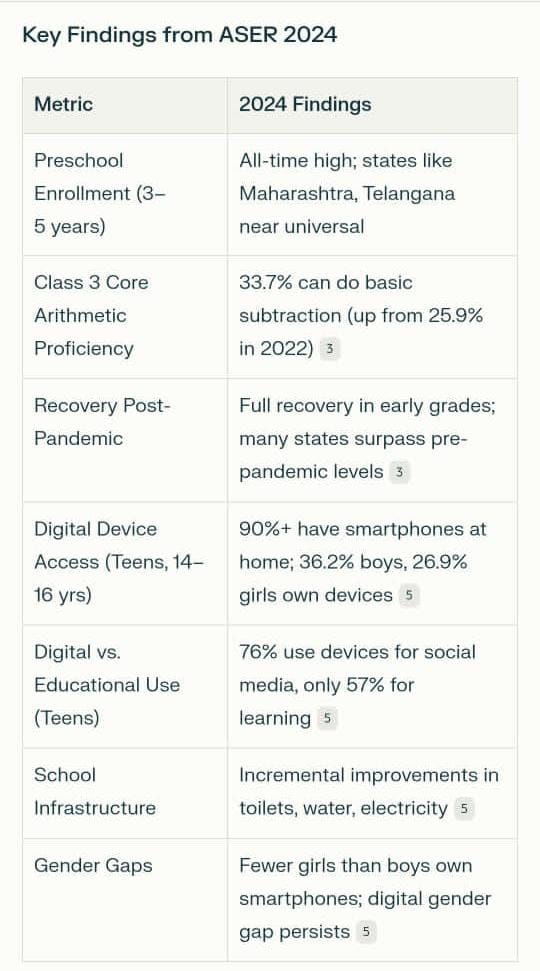
Learning Outcomes:
Notable improvements in arithmetic and reading skills in primary classes. Yet, skill levels remain below desired benchmarks—just 33.7% of Class 3 children can do basic subtraction.
1.Digital Literacy:
Near-universal smartphone access at home but significant disparities in ownership and educational usage, especially by gender.
2.School Infrastructure:
Improvements are steady but uneven, with gaps in teacher availability and facility upgrades persisting.
The Indian Education System: Transformation and Trials
Policy Reforms: NEP 2025
The National Education Policy (NEP) 2025 pushes for a holistic, tech-integrated, and multilingual system, aiming for adaptability and global competitiveness.
1.Curricular Overhaul: The new 5+3+3+4 structure addresses learning needs at every developmental phase (from foundational years to secondary). – Mother Tongue Instruction: Emphasis on teaching in regional languages up to Class 5.
2.Vocational and Skill-Based Education: Early integration of coding, artificial intelligence, and vocational skills from Class 6 onwards.
3.AI and Digital First: India’s 2025 education vision includes AI learning modules for Classes 6–12, personalized learning platforms, and the ambitious “Year of AI” as declared by AICTE.
4.Budget Priorities: The education allocation in the 2025-26 Union Budget reaches ₹1.28 lakh crore, focusing on teacher training, digital infrastructure, and upgrading schools under the PM SHRI initiative.
Persistent Challenges
1.Teacher Shortage: Over 1 million teacher vacancies threaten quality and consistency.
2.Learning Gaps: Despite recovery, the majority of rural adolescents remain behind grade-level expectations.
3.Digital Divide: Device and internet quality vary widely across regions; the gender gap in digital access continues to undermine equity in learning opportunities.
4.Smartphone Usage Patterns: While access is high, most teenagers spend far more time on social media than on educational platforms.
Live Examples: Kids, Bots, and Blended Learning
Case 1: Priya’s Day in Maharashtra
Priya, a Ballarpur, Maharashtra, Class 8 student, uses a chatbot for instant math explanations and practice problems. When she struggles to interpret a complex poem in her mother tongue, the AI falters—here, her teacher’s cultural context and encouragement prove irreplaceable.
Case 2: Pratham’s TaRL Success in Rural India
At a Pratham Teaching at the Right Level (TaRL) camp in Odisha, children are grouped by ability, not age. Using both peer learning and educational apps, students double their literacy rates within weeks—demonstrating that when technology is combined with mentorship and tailored instruction, foundational learning soars.
The Role of AI in Indian Education
Benefits
1.Personalized Remediation: AI enables adaptive learning paths, allowing students to progress at their own pace and get instant feedback.
2.Bridging Access Gaps: Through vernacular content, AI helps under-resourced regions and linguistic minorities access quality material.
3.Teacher Empowerment: AI can automate grading and administrative tasks, freeing teachers to focus on deeper learning and motivation.
Limitations and Risks
1.Lack of Contextual Sensitivity: AI tools still struggle to navigate open-ended, creative, or contextually rich tasks.
2.Quality of Engagement: Excessive reliance on bots risks reducing deep teacher-student engagement, essential for critical thinking and emotional development.
3.Digital Misuse & Distraction: With the push towards devices, social media and non-educational use often outpace quality learning on screens.
Pratham’s TaRL: A Deep-Dive Case Study Teaching at the Right Level (TaRL)—a flagship Pratham model—stands out as one of the most rigorously researched and scaled interventions worldwide
Over 50 million children in India have benefited from TaRL approaches.
- Independent evaluations show significant gains in both reading and math, and a substantial reduction in dropouts.
- TaRL’s effectiveness is highest when it combines structured materials, ongoing teacher mentoring, regular assessment, and student grouping by actual ability rather than age or grade.
- The model is now being adapted internationally, showing that India’s education innovations can have global relevance.
Conclusion & Recommendations
The contest isn’t simply whether a child can beat the bot, but whether they can leverage technology with human guidance for deeper, more meaningful learning. Technology and AI are crucial accelerators—but only as part of a system where strong foundational teaching, social-emotional learning, and equity are kept at the center.
Action Points for a Future-Ready Education:
1.Blended Strategies: Use chatbots and digital tools to supplement—not replace—teacher-led and peer-based learning.
2.Universal Digital Access: Close the gender and region-based device gap, ensuring all students have reliable access to quality devices and connectivity.
3.Teacher Development: Prioritize regular, practical training and mentorship programs for teachers to use tech meaningfully.
4.Focus on Foundational Skills: Maintain programs like Pratham’s TaRL that have proven effectiveness in catching up lagging learners.
5.Continuous and Inclusive Assessment: Leverage AI for ongoing feedback, but couple with teacher observation and holistic assessment.
6.Promote Responsible Tech Culture: Educate students about responsible, purposeful digital use to minimize digital distractions and misuse.
Ultimately, the winners in India’s education system will be neither bots nor children alone, but those who learn to combine the strengths of both—guided, inspired, and empowered by great teachers.