When we look at the night sky, we see stars — but our solar system is also home to special worlds called planets. This topic is popular because children love learning how planets travel through space and why Earth is the only known planet with life.
A planet is a large object in space that moves around a star, just like Earth moves around the Sun.
What is a planet?
A planet:
-
Does not make its own light
-
Moves around a star
-
Is round in shape
-
Has cleared its path in space
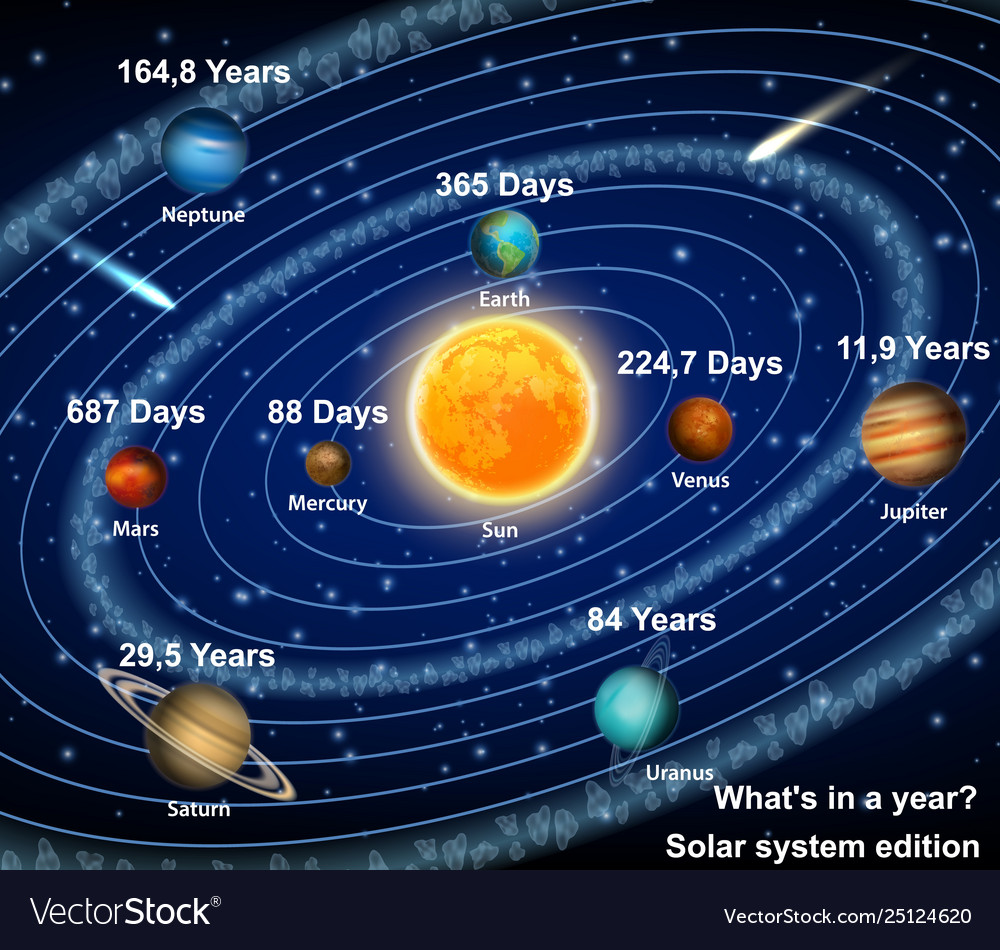
Our solar system has eight planets, all moving around the Sun.
The eight planets of our solar system
The planets, in order from the Sun, are:
-
Mercury
-
Venus
-
Earth
-
Mars
-
Jupiter
-
Saturn
-
Uranus
-
Neptune
Each planet is different in size, temperature and appearance.
How planets move
Planets move around the Sun in a path called an orbit.
This movement is called revolution.
At the same time, planets also spin on their own axis. This spinning is called rotation.
-
Rotation causes day and night
-
Revolution causes years and seasons
Why Earth is special
Earth is special because:
-
It has air to breathe
-
It has liquid water
-
It has the right temperature for life
-
It supports plants, animals and humans
Scientists are searching for planets like Earth in other solar systems.
Gas giants and rocky planets
Planets are grouped into two types:
-
Rocky planets: Mercury, Venus, Earth, Mars
-
Gas giants: Jupiter, Saturn, Uranus, Neptune
Gas giants are huge and made mostly of gases, not solid ground.
Why kids should care
-
Planets help us understand space
-
Space science inspires curiosity
-
Future explorers may visit other planets
Teachers say learning about planets helps children imagine big ideas and understand Earth’s place in space.
Fun fact
Jupiter is so big that more than 1,000 Earths could fit inside it!
In short: Planets are worlds that move around the Sun, each with unique features.
Learning takeaway: Studying planets helps us understand the universe — and reminds us how special our home planet Earth truly is. 🌍✨