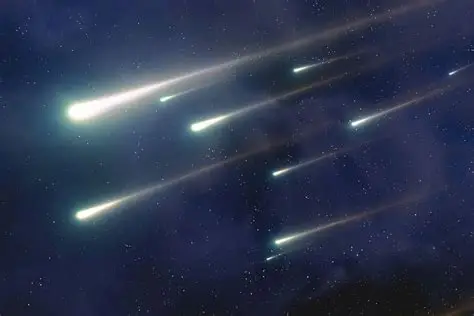
Have you ever seen a bright streak of light flash across the night sky and disappear in seconds? Many people call it a shooting star, but it is actually a meteor. This topic is popular because meteor showers happen every year and fascinate children and adults alike.
Meteors are not stars at all — they are small pieces of rock or dust from space.
What is a meteor?
A meteor starts as a meteoroid, which is a tiny piece of rock or metal floating in space.
When it enters Earth’s atmosphere at high speed, it heats up and glows — and that glowing streak is called a meteor.
If a piece survives and reaches the ground, it is called a meteorite.
Why meteors glow
Meteors glow because:
-
They travel extremely fast
-
Air resistance creates heat
-
The surface burns and shines
This light is what we see as a shooting star.
What is a meteor shower?
A meteor shower happens when:
-
Earth passes through a cloud of space debris
-
Many meteors appear in the sky
-
They seem to come from the same area
Famous meteor showers include the Perseids and Geminids, which can be seen every year.
Are meteors dangerous?
Most meteors:
-
Are very small
-
Burn up completely in the sky
-
Never reach the ground
Large meteorites are rare, and scientists track space objects to keep Earth safe.
Why meteors are important
Meteors help scientists:
-
Learn about the early solar system
-
Study materials from space
-
Understand Earth’s atmosphere
Some meteorites are older than Earth itself.
Why kids should care
-
Meteors make space exciting
-
Watching the sky builds curiosity
-
Astronomy inspires future scientists
Teachers say meteor showers are a fun way to learn space science by simply looking up.
Fun fact
On a clear night, you can see several meteors per hour without any telescope!
In short: Shooting stars are actually meteors — tiny space rocks burning up in Earth’s atmosphere.
Learning takeaway: The night sky is full of surprises, and even small space rocks can teach us big lessons about the universe. 🌌✨