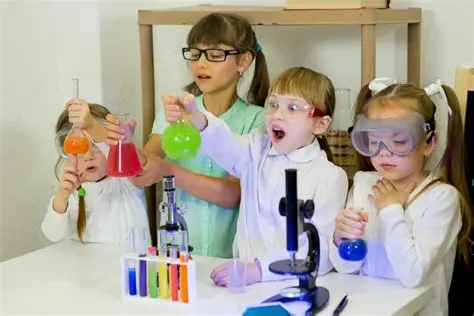
Education experts say that doing simple science experiments helps students understand scientific concepts more clearly, making this an important science learning and student skills news story. Experiments allow students to observe how things work in the real world instead of only reading about them in books.
Science is based on observation, testing, and discovery. Experts explain that experiments help students see cause and effect, which improves understanding of scientific ideas.
For example, students can learn about air pressure, gravity, and chemical reactions through small experiments using simple household materials.
For students, this news matters because hands-on learning makes science more interesting and easier to remember.
One simple experiment is the baking soda and vinegar reaction, which produces bubbles of carbon dioxide gas. This activity helps students understand chemical reactions.
Another example is observing how plants grow when placed in sunlight versus shade. This experiment helps students learn about photosynthesis and plant growth.
Floating and sinking experiments using water and different objects help explain density and buoyancy.
Experts say experiments encourage curiosity and help students ask questions about how the world works.
Hands-on science activities also develop observation and critical thinking skills.
Teachers often include experiments in science lessons to make learning interactive.
Students can record observations and results in a science notebook, which improves scientific thinking.
Parents can support science learning by encouraging safe experiments at home with supervision.
Experts recommend starting with simple experiments that use safe materials and clear instructions.
Science fairs and project exhibitions give students opportunities to present their experiments and discoveries.
Researchers say hands-on learning helps students remember concepts longer than reading alone.
Experiments also help students develop patience and problem-solving abilities.
Learning through experiments encourages creativity and curiosity about science and technology.
Experts emphasize that asking questions and testing ideas are important parts of scientific discovery.
By performing simple science experiments, students can understand scientific concepts better, develop curiosity, and build skills that support future learning in science and technology.