
NASA Roman Space Telescope Gets Super-Sharp Vision
NASA's Nancy Grace Roman Space Telescope has completed its initial tests in deep space, sending back views nearly 30% sharper than scientists expected!
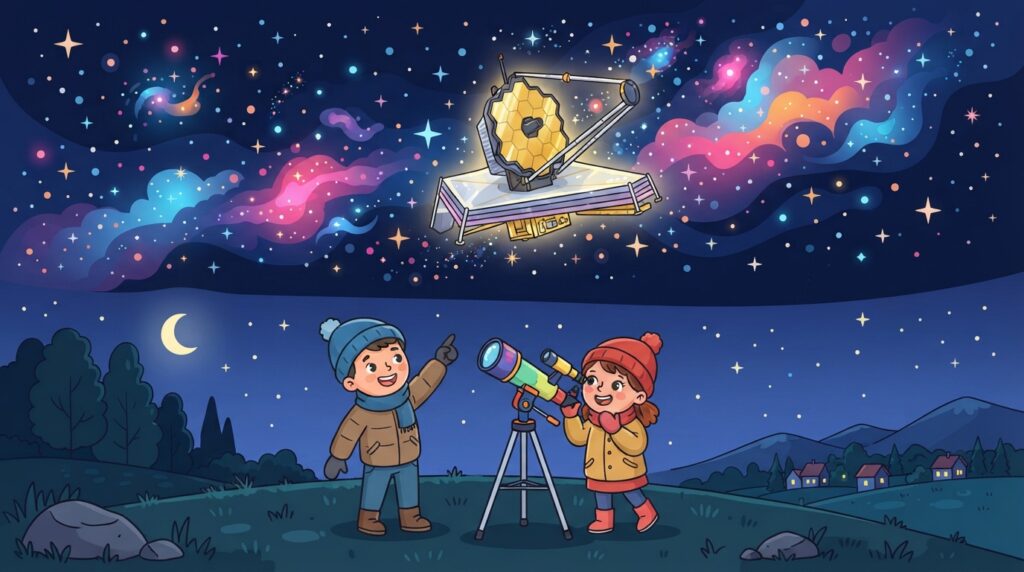
Space scientists have shared some exciting news from deep space! On 17 October 2026, NASA announced from the Goddard Space Flight Center in Greenbelt, Maryland, that its newly launched Roman Space Telescope is performing even better than anyone hoped.
The huge cosmic observatory has successfully finished its first optical checkouts. Its view of the universe is nearly 30% sharper than original predictions, which means it will give astronomers an extraordinarily crisp look at distant stars and mysterious worlds.
What happened?
The Nancy Grace Roman Space Telescope began its journey on 30 August 2026. It blasted into space aboard a SpaceX Falcon Heavy rocket from Launch Complex 39A at NASA’s Kennedy Space Center in Florida. The spacecraft is now travelling towards its operational orbit around Sun–Earth Lagrange Point 2, also called L2. This special cosmic parking spot is roughly 1.5 million kilometres (or 1 million miles) away from Earth.
To achieve this super-clear eyesight, engineers had to make unbelievably tiny adjustments. They shifted a mirror by an amount equal to just one-sixteenth the width of a single human hair! NASA systems engineers Maxime Rizzo and Dave Hickey compared calibrating the telescope’s parts in deep space to tuning musical instruments before a major concert.
This careful tuning worked wonders. The optical error for the primary instrument was measured at just 63 nanometres root-mean-square (RMS). That easily beat the mission requirement threshold of 90 nanometres RMS. A lower number means the telescope’s vision is much sharper than planned!
The observatory features a main camera called the Wide Field Instrument (WFI). It is packed with 18 sensitive detectors that combine to capture a massive 300.8-megapixel view of the cosmos. The main mirror of the telescope is 2.4 metres across, which is the exact same size as the famous Hubble Space Telescope’s mirror. However, Roman can capture an area of the sky at least 100 times larger in a single snapshot!
Why does it matter to you?
Have you ever looked up at the night sky from your balcony or school ground in India and wondered what lies beyond the stars? Telescopes act like giant cosmic time machines and cameras, helping us uncover the deepest secrets of our universe.
Because this observatory can see nearly 30% sharper than expected, it will help discover thousands of brand-new exoplanets beyond our solar system. It will also help scientists map invisible dark matter and study dark energy. Every day, Roman will send back about 1.4 terabytes of astronomical data, giving young stargazers and future Indian scientists exciting discoveries to explore for years to come.
Words to know
- Exoplanet: A planet that orbits a distant star outside our own solar system.
- Nanometre: An ultra-tiny unit of measurement equal to one-billionth of a metre.
- Lagrange Point 2 (L2): A balanced gravitational spot in deep space where spacecraft can stay in a steady position relative to the Earth and the Sun.
- Dark matter: A mysterious substance in space that cannot be seen directly, but pulls on other matter with its gravity.
Did you know?
Even though Roman’s mirror is the same size as the Hubble Space Telescope’s mirror, it can photograph an area of sky at least 100 times larger in just one snap!
Think about it
If you could use Roman’s 300.8-megapixel camera to take a picture of any corner of deep space, what cosmic secret would you hope to find?
Quick quiz
How much sharper is the Roman Space Telescope’s vision compared to original predictions?
- Nearly 10%
- Nearly 30%
- Nearly 50%
See the answer
Nearly 30%
Sources
This story was prepared by the Kids Gazette news desk with the help of AI research and writing tools, using the sources listed above.