
Hera Spacecraft Reaches Crash Site in Deep Space
Europe's Hera spacecraft has arrived at the asteroid Dimorphos to inspect the crash site created by NASA's DART mission.
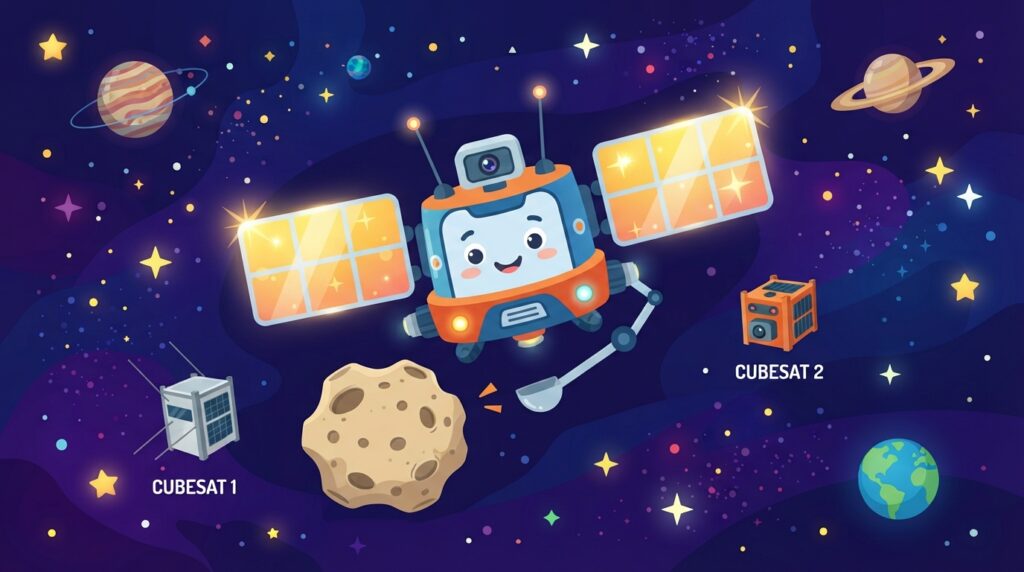
A brilliant cosmic detective story has just reached an exciting new chapter! On 20 October 2026, the European Space Agency’s (ESA) Hera spacecraft reached a pair of space rocks called Didymos and Dimorphos. This amazing Hera spacecraft asteroid mission is taking place an incredible 195 million kilometres away from Earth.
Hera first blasted off from Cape Canaveral on 7 October 2024. Its big goal is to inspect the exact spot where an American spacecraft intentionally smashed into an asteroid four years ago.
What happened?
Back on 26 September 2022, a NASA spacecraft called DART slammed right into the 160-metre-wide asteroid moonlet named Dimorphos. DART was travelling at a superfast speed of 6.1 kilometres per second, which is nearly 22,000 kilometres per hour! That collision successfully changed the path of Dimorphos around its larger 800-metre partner, Didymos, cutting its travel time from 11 hours 55 minutes down to roughly 11 hours 22 minutes.
Now, Hera has arrived to see the results up close. Engineers at the European Space Operations Centre in Darmstadt, Germany, helped Hera slow down by firing its thrusters for a 93-minute braking burn called BRM-1. A huge 35-metre antenna located in New Norcia, Australia, caught the radio signals sent from Hera, as confirmed by flight dynamics engineer Francesco Castellini.
The team planned a second 31-minute braking burn for 22 October 2026 to match the speed of the space rocks, followed by three smaller burns to bring its relative speed down near zero. Then, in November 2026, Hera will start its Early Characterisation Phase by flying as close as 30 kilometres from Dimorphos to snap clear, detailed pictures of the crash area.
Hera is roughly the size of a car and carries 12 special science instruments. It also carries two tiny, shoebox-sized helpers called CubeSats, named Juventas and Milani. These little probes will measure the gravity and inside layers of the asteroid before trying to touch down on its surface.
Astrophysicist Martin Jutzi from the University of Bern shared that Hera’s data will show how well kinetic impacts work and reveal the exact energy transferred to the asteroid.
Why does it matter to you?
Have you ever watched science fiction movies where brave heroes protect our home planet from giant space rocks? This mission proves that real scientists are actually building tools to keep Earth safe.
By learning how a spacecraft nudge can push an asteroid off course, scientists across different nations are creating a real-life planetary shield. This wonderful teamwork shows that when people across the globe join hands, we can solve giant puzzles and make the universe a safer home for everyone, including you and your family here in India.
Words to know
- Asteroid: a rocky object that orbits the Sun, smaller than a planet.
- Binary asteroid: a pair of space rocks that orbit around each other.
- Kinetic impact: hitting an object hard and fast to push it or change its direction.
- CubeSat: a very small, box-shaped satellite used for space research.
Did you know?
The tiny asteroid Dimorphos is only about 160 metres across, which is roughly the length of one and a half cricket grounds placed end to end!
Think about it
If you were asked to design a tiny satellite like Juventas or Milani, what special gadget would you put inside it to study a space rock?
Quick quiz
What are the names of the two shoebox-sized CubeSats carried by Hera?
- Didymos and DART
- Juventas and Milani
- Bern and Darmstadt
See the answer
Juventas and Milani
Sources
This story was prepared by the Kids Gazette news desk with the help of AI research and writing tools, using the sources listed above.