Ancient Mars Meteorite Found in Sahara Desert
Scientists confirmed that a pinkish 4.1-billion-year-old Mars meteorite found in the Sahara Desert holds clues about ancient water on the Red Planet.
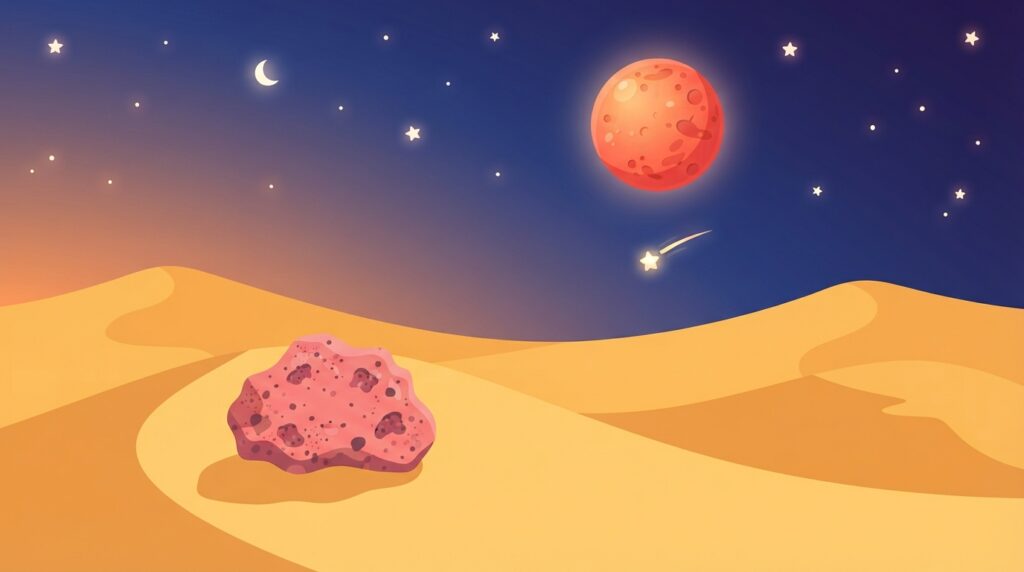
Imagine holding a real piece of another planet right in the palm of your hand! Scientists have confirmed that a lovely rose-coloured rock found in the Sahara Desert in Mali is an ancient Mars meteorite. Named Teghaza 001, this rare treasure travelled millions of kilometres through space before crashing onto Earth.
On 30 October 2026, researchers revealed that this space stone formed over 4.1 billion years ago as part of the original crust of Mars. It is an extraordinary scientific discovery because it allows researchers to study the early days of our solar system without ever leaving our home planet.
What happened?
The story began in 2022 when eight mysterious rock fragments were found resting on the sands of Mali in the Sahara Desert. Together, the fragments weigh roughly 800 grams (specifically 798.5 grams). The single largest piece measures about 10 centimetres across and weighs 442 grams.
A team of scientists, led by Dr. Yang Liu of NASA’s Jet Propulsion Laboratory (JPL) in Southern California, conducted a detailed study published in the journal Science. Experts Carl Agee and Karen Ziegler from the University of New Mexico’s Institute of Meteoritics assisted by carrying out oxygen isotope tests and electron microprobe examinations.
The scientists discovered that the rock is an intact volcanic stone called a plagioclase-rich gabbroic diorite. The coarse grains inside the rock show that it cooled down slowly deep underground. By tracking how uranium slowly broke down into lead inside tiny zircon crystals, they found the rock formed 4.11 billion years ago. Another test using rubidium and strontium pointed to an age of roughly 4.24 billion years!
To date, people have discovered approximately 435 Martian meteorites on Earth, but most of them are younger rocks that formed less than 2.4 billion years ago. Teghaza 001 is among the three oldest Martian meteorites ever identified. Even more excitingly, the rock shows signs of mineral changes caused by liquid water flowing underground billions of years ago. Because it tells such a rich story about the geology and fluids of young Mars, one reviewer called it a Rosetta Stone for Mars.
Why does it matter to you?
When you look up into the evening sky from your rooftop or school ground in India, the Red Planet looks like a tiny orange dot. Discoveries like Teghaza 001 prove that distant planets are not unreachable mysteries. We can actually pick up, hold, and examine pieces of them right here on Earth!
Knowing that Mars had liquid water underground over four billion years ago makes space exploration thrilling for young minds. It shows that ancient Mars was active, warm, and wet rather than just a dry desert. For any Indian child dreaming of joining space programmes or becoming a geologist, this rock proves that space rocks still hold clues waiting to be solved.
Words to know
- crust: The solid, rocky outermost surface layer of a planet.
- meteorite: A rock from outer space that passes through the atmosphere and lands on the ground.
- zircon: A tough, microscopic mineral crystal that acts like a natural clock to tell scientists how old a rock is.
- primordial: Belonging to the very earliest stages of a planet or time in history.
Did you know?
Out of more than 70,000 meteorites discovered on Earth, only about 435 have been confirmed to come directly from Mars, making them rarer than gold!
Think about it
If Mars had liquid water underground more than four billion years ago, what else do you think scientists might discover inside ancient space rocks? How does holding an ancient rock help us understand our own planet Earth?
Quick quiz
How old did scientists determine the zircon crystals inside the Teghaza 001 meteorite to be?
- 4.11 billion years
- 2.4 billion years
- 800 million years
See the answer
4.11 billion years
Sources
This story was prepared by the Kids Gazette news desk with the help of AI research and writing tools, using the sources listed above.