Sri Lanka Opens Its Very First Atal Tinkering Lab
Sri Lanka has inaugurated its first Atal Tinkering Lab at Nalanda College in Colombo, bringing robotics, AI tools, and 3D printers to young learners.
Have you ever dreamed of assembling your own robot or designing a gadget with a 3D printer? On 4 November 2026, students at Nalanda College in Colombo, Sri Lanka, celebrated a wonderful milestone as their school opened the nation’s very first Atal Tinkering Lab at its Innovation Center.
This exciting opening marks the first time that India’s school-focused tinkering and innovation framework has expanded beyond its national borders. Thanks to technical guidance and specialised training from India, students in Sri Lanka can now dive into hands-on technology right inside their own school building!
What happened?
The new laboratory was created with technical guidance, specialised curricula, and training support from India’s Atal Innovation Mission, also known as AIM. AIM is a special initiative that functions under NITI Aayog in India. To make this international project happen, the High Commission of India in Sri Lanka helped guide the way. This teamwork formed an active trilateral collaboration among Nalanda College, India’s Atal Innovation Mission, and Atlas Axillia, which is the education-focused subsidiary of Hemas Holdings.
The opening ceremony was an inspiring event for everyone present. Santosh Jha, the High Commissioner of India to Sri Lanka, addressed the gathering and spoke about the growing bilateral friendship and joint educational vision shared by the two countries. Sri Lankan cricket icon Mahela Jayawardene also attended the inaugural event as a special guest, celebrating together with enthusiastic educators and students. Ashish Chandra, a representative at the event, described this distinctive new facility at Nalanda College as the first of its kind in Sri Lanka.
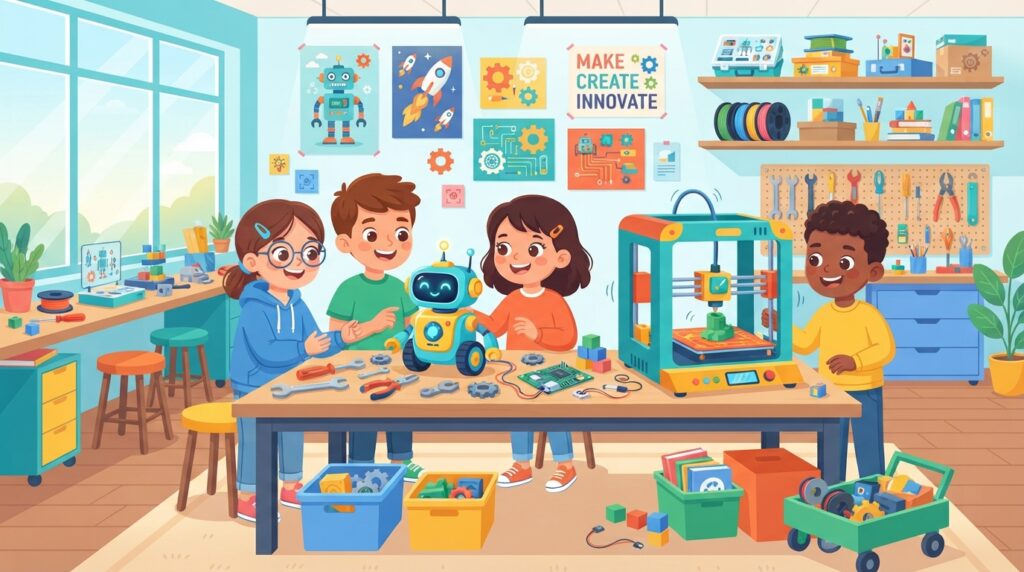
Inside the room, young inventors will find plenty of modern, hands-on learning technologies. The lab is equipped with robotics kits, artificial intelligence tools, 3D printers, and digital manufacturing hardware. With these modern resources, the lab aims to help school students construct working prototypes, design automated gadgets, and apply their classroom STEM concepts to solve real-world challenges.
Why does it matter to you?
If you study in India, you might already have an innovation space at your school or know friends who build science models in one. It is thrilling to see how the fun, practical tech projects enjoyed by Indian students are now reaching out to inspire young minds across our borders.
This cross-border partnership shows that learning to build robots, understand artificial intelligence, and create 3D inventions can connect children across different nations. When students everywhere are given the right tools, they can discover creative solutions to everyday problems together.
Words to know
- Tinkering: experimenting with parts, materials, and tools in a hands-on way to invent or improve things.
- Prototype: an early, working model of an invention made to test an idea.
- Artificial intelligence: smart computer programmes designed to perform tasks that usually need human thinking.
- Curriculum: the regular study programme and lessons planned for students in a school.
Did you know?
More than 10,000 Atal Tinkering Labs have already been set up across 722 districts in India, engaging over 1.1 crore students in creative problem-solving!
Think about it
If you were given access to 3D printers and robotics kits, what kind of automated gadget would you choose to build first? How could your new invention help your friends, your school, or your neighbourhood?
Quick quiz
Where was Sri Lanka’s first Atal Tinkering Lab inaugurated?
- Nalanda College in Colombo
- National Museum in Kandy
- Atlas Axillia Center in Galle
See the answer
Nalanda College in Colombo
Sources
This story was prepared by the Kids Gazette news desk with the help of AI research and writing tools, using the sources listed above.