
Traces of Dinosaur Blood Found in Fossil Bone!
Scientists have discovered 115-million-year-old traces of dinosaur blood preserved inside a fossil leg bone from Brazil.
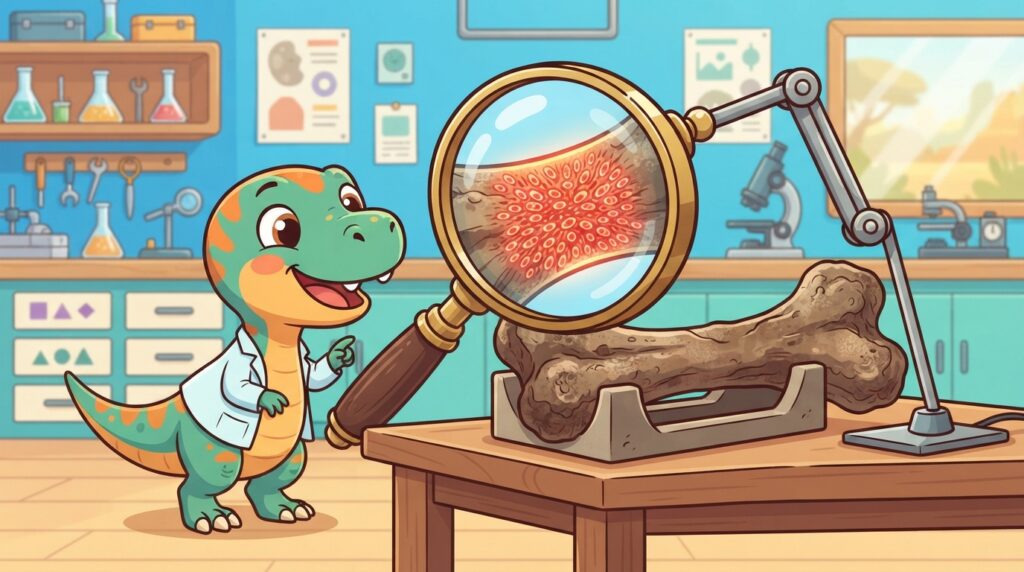
Imagine peering deep inside a solid rock and finding actual biological clues from a creature that lived over a hundred million years ago! On 6 November 2026, an international research team led by Curtin University in Australia revealed an astonishing breakthrough. Scientists discovered fossilised red blood cells and microscopic traces of dinosaur blood preserved deep inside an ancient fossil bone.
The bone once belonged to an exciting creature named Aratasaurus museunacionali, which lived about 115 million years ago during the Early Cretaceous period. Workers initially unearthed the right hind-limb bone from a mine in the Romualdo Formation in northeastern Brazil back in 2008, after which it was kept in the National Museum of Brazil. Now, scientists working between Brazil and Perth, Australia, have revealed the hidden treasures tucked inside it.
What happened?
The research study was led by organic geochemist Professor Kliti Grice and published in the scientific journal Proceedings of the National Academy of Sciences (PNAS). To study the fossil, the team examined the tiny vascular canals inside the leg bone where blood vessels once flowed when the dinosaur was alive.
Inside these microscopic passages, the team discovered numerous oval-shaped structures. These tiny shapes measured approximately 23 micrometres long and 20 micrometres wide, looking just like red blood cells. The scientists wanted to know whether any original organic material still remained after millions of years.
Using high-precision chemical tests, the scientists confirmed the presence of heme B. This is the iron-rich molecule in haemoglobin that carries oxygen around the body and gives red blood cells their red colour. Alongside heme B, the team detected amino acids linked to collagen, which is an essential structural protein found in animal bones and connective tissues.
These delicate components survived because they were mineralised with hausmannite, a tough manganese oxide mineral. This mineral acted like a natural protective time capsule, shielding the organic parts from weathering and decay. Scientists calculate that the young, two-legged, meat-eating theropod was about 3 metres (10 feet) long and weighed around 34 kilograms (75 pounds) when it died.
Why does it matter to you?
When you visit a museum or read your science textbook in school, it is easy to think of dinosaurs as just dry skeletons made of stone. Most people assume soft body parts like blood and proteins always disappear completely when an animal turns into a fossil.
This landmark discovery proves that soft biological clues can survive for more than 100 million years inside rocks. Instead of only studying hard bones, future scientists—perhaps even you one day—can look at chemical traces to explore how ancient animals breathed, grew, and lived. It shows that our planet’s oldest rocks still hold secret details waiting for sharp eyes and clever instruments to find them!
Words to know
- Theropod: a group of two-legged, meat-eating dinosaurs.
- Haemoglobin: a protein found in red blood cells that carries oxygen through the body.
- Collagen: a strong structural protein that builds bones and connective tissue.
- Micrometre: an extremely small unit of length equal to one-thousandth of a millimetre.
- Hausmannite: a manganese oxide mineral that helped preserve the ancient blood cells.
Did you know?
Researchers confirmed that this find is the oldest chemical confirmation of blood components ever recorded in a dinosaur!
Think about it
If you could examine any ancient fossil under a powerful scientific microscope, what creature would you choose? How do you think learning about dinosaur blood can help us better understand animals alive today?
Quick quiz
Which mineral helped preserve the ancient dinosaur blood cells like a natural time capsule?
- Hausmannite
- Granite
- Quartz
See the answer
Hausmannite
Sources
This story was prepared by the Kids Gazette news desk with the help of AI research and writing tools, using the sources listed above.