
World’s First Wooden Satellite LignoSat Launches
Scientists have launched LignoSat, the world's first wooden satellite, into space to test how timber survives cosmic conditions and cuts space pollution.
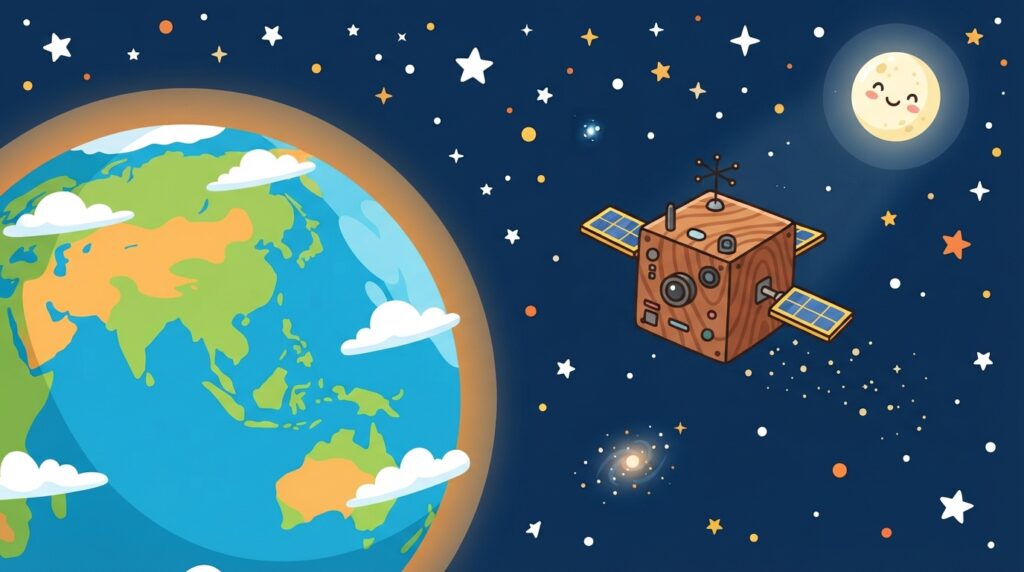
Imagine sending a small block of forest timber straight up towards the stars! On 4 November 2024, space history was made when the tiny wooden satellite LignoSat launched into space from NASA’s Kennedy Space Center in Florida, United States.
This eco-friendly spacecraft was jointly created by researchers at Kyoto University and Sumitomo Forestry, a Japanese forestry and homebuilding company. It blasted off aboard an uncrewed SpaceX Dragon cargo capsule on a Falcon 9 rocket, heading towards the International Space Station.
What happened?
LignoSat has an important job, but it is delightfully small. It is a palm-sized cube measuring only 10 centimetres on each side and weighing just 900 grams. Instead of using common metal sheets, scientists constructed the satellite’s outer frame from honoki wood, a type of Japanese magnolia. For centuries, craftspeople in Japan traditionally used this sturdy wood to carve scabbards for samurai swords!
To put the box together, builders relied on a traditional Japanese woodworking method. They did not use any metal screws, nails, or glue. Instead, the panels interlock perfectly like an intricate wooden puzzle. Inside, sensors are ready to study how the timber handles outer space.
The craft flew to the International Space Station, also called the ISS, where astronauts will prepare it for release into low Earth orbit at an altitude of around 400 kilometres. During its six-month mission, LignoSat will face wild conditions. It will experience strong cosmic radiation and harsh temperature shifts from -100°C to 100°C every 45 minutes.
You might wonder why the timber does not catch fire or turn to dust. In the airless vacuum of space, there is neither oxygen nor moisture. Because of this, wood cannot rot, decay, or burn while floating in orbit. Regular metal satellites release harmful aluminium oxide particles when they fall back and burn up in the atmosphere. Wooden satellites, however, incinerate cleanly and help combat space pollution.
Project leader Takao Doi, a former astronaut and professor at Kyoto University, explained that testing timber in space is a great first step. In the future, this research could help humans build habitats and wooden structures on the Moon and Mars.
Why does it matter to you?
Here in India, we take great pride in exploring space and protecting our green environment. From reducing plastic rubbish to saving electricity, finding eco-friendly alternatives is important for our planet’s future.
LignoSat proves that ancient craft skills and natural materials can solve modern scientific problems. It shows school students that green thinking is not just for gardens and recycling bins on Earth. With smart ideas, nature could help us build future homes across the solar system!
Words to know
- scabbard: a tight protective cover or sheath made to hold the blade of a sword safely.
- vacuum: a completely empty space that contains no air, gas, or moisture.
- satellite: an object sent into orbit around a planet to collect data or relay signals.
- radiation: invisible streams of energy travelling through space that can affect objects and living things.
- habitat: a safe, built structure or natural environment where people or creatures can live.
Did you know?
Because there is zero oxygen and no moisture in the vacuum of space, a piece of wood in orbit will never decay, grow mould, or rot away!
Think about it
If you were asked to design a lunar house for future explorers, which natural materials from Earth would you choose to test?
How can traditional Indian craft techniques be combined with modern technology to protect our environment?
Quick quiz
What type of wood was used to build the outer frame of LignoSat?
- Honoki wood
- Teak wood
- Pine wood
See the answer
Honoki wood
Sources
This story was prepared by the Kids Gazette news desk with the help of AI research and writing tools, using the sources listed above.