Euclid Space Telescope Unveils Giant Cosmic Map
The European Space Agency has shared the Euclid space telescope's first massive dataset, charting over one billion objects across deep space.

Imagine looking up at the night sky and being able to spot more than a billion shining cosmic objects at once! On 12 November 2026, space scientists at the European Space Agency in Darmstadt, Germany, shared an exciting treasure chest of discoveries. They released the first major batch of Euclid space telescope data, giving researchers all over the planet their clearest peek yet into deep space.
The special dataset is called DR1-Foundation. It captures light from deep across the cosmos to lay the groundwork for the biggest and most detailed 3D map of our universe ever made.
What happened?
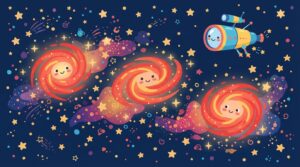
To put this giant project together, the Euclid space telescope spent roughly 13 months studying the sky, from spring 2024 to spring 2025. It surveyed 1,900 square degrees of the sky, which covers an area as vast as 9,500 full moons shining together! In total, the space observatory collected around 1.7 million gigabytes of survey information.
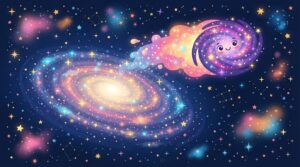
This new cosmic catalogue is packed with incredible wonders. Scientists counted over 900 million galaxies and spotted more than 60 million quasar candidates shining brightly across the universe. They also identified around 15,000 candidates for strong gravitational lenses. These special lenses happen when the powerful gravity of a massive galaxy bends light coming from objects hidden behind it, acting just like a giant magnifying glass floating in space.
Euclid also put together a stunning northern sky mosaic. This breathtaking picture combines 740 separate observations, covers 367 square degrees, and reaches nearly 500 gigapixels in size! Professor Carole Mundell, the Director of Science at the European Space Agency, noted that the release marks a major scientific milestone. She highlighted that it is the largest space-based survey of its kind.
Euclid began its exciting journey when it launched in July 2023. Today, it travels in a quiet orbit roughly 1.5 million kilometres away from Earth at a position called Lagrange Point 2. From there, it is carrying out a six-year mission to study dark matter and dark energy, which are mysterious invisible forces that shape our cosmos.
Why does it matter to you?
Have you ever stepped onto your terrace or balcony on a clear night in India and wondered what lies past the twinkling stars? While human eyes can only see a small handful of bright dots, Euclid can see billions of distant worlds.
This massive space map gives curious young stargazers a front-row seat to the hidden architecture of outer space. By showing how galaxies formed and evolved over billions of years, Euclid is building a cosmic guide for the future. One day, students in classrooms across India might use this exact information to help solve the greatest mysteries of how our universe works!
Words to know
- Galaxy: A massive cosmic neighbourhood made of billions of stars, planets, gas, and dust held together by gravity.
- Quasar: An extremely bright and energetic centre of a distant galaxy powered by a supermassive black hole.
- Gravitational lens: A natural magnifying effect that happens when gravity from a heavy cosmic object bends the light of things behind it.
- Gigabyte: A standard unit used to measure large amounts of digital computer data.
Did you know?
The Euclid space telescope floats at Lagrange Point 2, which is about 1.5 million kilometres away from Earth—nearly four times farther away than our Moon!
Think about it
If you could send a robotic telescope anywhere in outer space, what kind of cosmic secret would you want it to photograph first?
Quick quiz
How large was the area of sky covered by Euclid’s new dataset compared to the Moon?
- As large as 500 full moons
- As large as 9,500 full moons
- As large as 1.5 million full moons
See the answer
As large as 9,500 full moons
Sources
This story was prepared by the Kids Gazette news desk with the help of AI research and writing tools, using the sources listed above.