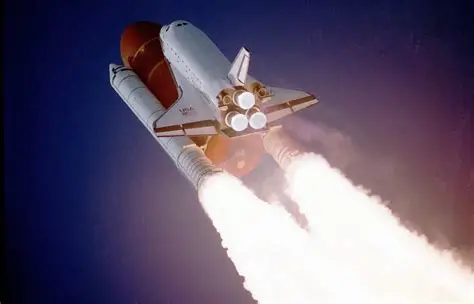
Rockets help humans explore space, launch satellites and study distant planets. This topic is popular because rockets are behind many space missions that children hear about in the news, including satellite launches and trips to the Moon and Mars.
A rocket is a powerful machine that can travel far above Earth by pushing itself upward with great force.
How a rocket works
A rocket works on a simple idea:
-
Push gas down
-
Move the rocket up
Inside a rocket, fuel burns and creates hot gases. These gases rush out from the bottom at very high speed. This strong push lifts the rocket into the sky.
This rule is called action and reaction — when something is pushed one way, it moves the other way.
Why rockets can go to space
Rockets can travel to space because:
-
They do not need air to work
-
They carry their own fuel and oxygen
-
They produce enormous power
Unlike airplanes, rockets can fly where there is no air.
What rockets carry
Rockets can carry:
-
Satellites for communication and weather
-
Astronauts into space
-
Space probes to study planets
-
Scientific tools for experiments
Some rockets are used only once, while others can return to Earth and be reused.
Why rockets are important
Rockets help humans:
-
Study Earth from space
-
Explore the Moon and Mars
-
Predict weather and storms
-
Improve communication and navigation
Many services we use daily, like GPS and television, depend on rockets.
Why kids should care
-
Rockets show the power of science and maths
-
Space exploration inspires big dreams
-
Future careers include astronauts and space engineers
Teachers say learning about rockets helps children understand physics, engineering and imagination together.
Fun fact
A rocket must travel faster than 28,000 kilometres per hour to stay in orbit around Earth!
In short: Rockets use powerful force to break free from Earth and explore space.
Learning takeaway: Rockets remind us that curiosity and science can take humans far beyond our planet. 🌍