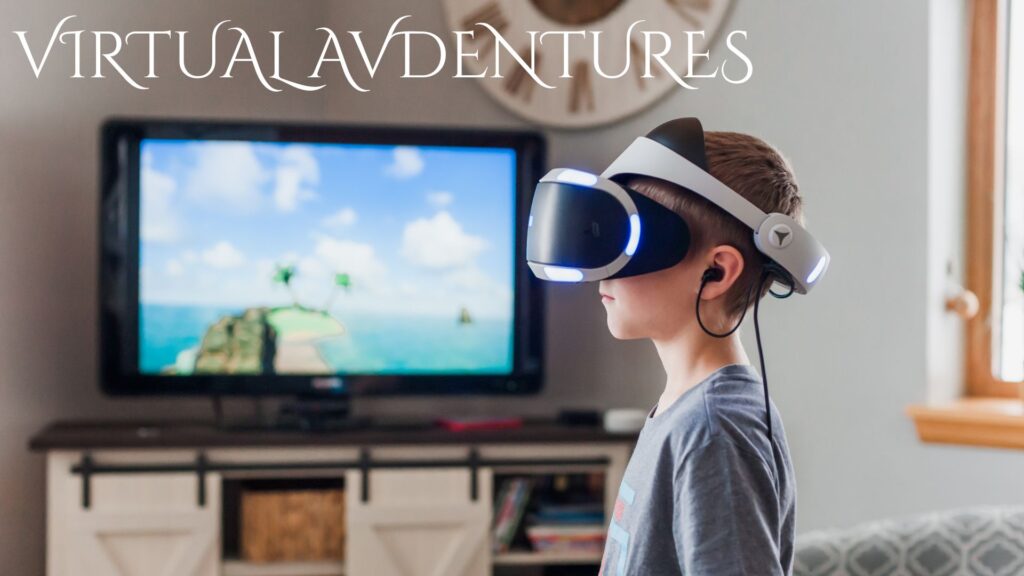
✨ “Mom, I just walked on Mars!”
That’s what 9-year-old Anvi shouted after using her VR headset during science class.
She didn’t really leave her living room — but for her mind, it was real. She explored red deserts, saw the Mars Rover, and even left digital footprints in the sand.
Her mother smiled and said, “You just had the best science class of your life.”
Welcome to the world of Virtual Reality (VR) and Augmented Reality (AR) — where learning feels like adventure and imagination becomes reality.
🌈 What Are VR and AR in Simple Words?
Let’s explain it like we would to a curious 10-year-old:
-
Virtual Reality (VR): When you wear special glasses or headsets, and suddenly you’re inside a different world — like a museum, jungle, or even space!
-
Augmented Reality (AR): When digital things appear in the real world. For example, your phone camera shows a dinosaur standing on your bed — that’s AR!
Together, VR and AR turn screens into windows of experience.
🎯 Example: The famous “Google Expeditions” app allows students to explore the Great Wall of China, the human heart, or even under the ocean — without leaving class.
🚀 The Learning Revolution – When Imagination Becomes the Classroom
1. History Comes Alive
Forget memorizing boring dates.
Now, with VR headsets, kids can walk through history.
In a Chennai school, students studying the Indus Valley Civilization used VR to tour ancient cities. They saw brick houses, pottery, and trade markets — all recreated virtually.
💬 “It felt like time travel,” said one student.
🧠 Fact Bite: Studies by Stanford University (2023) showed that students who used VR for history lessons remembered 29% more details compared to traditional reading.
History is no longer about remembering — it’s about experiencing.
2. Science You Can Step Into
Imagine learning the solar system not from a chart, but by flying through it!
In some Delhi schools, students wear VR goggles to explore the human body. They “walk inside” the heart, watching blood flow through veins in real time.
That’s the magic of immersive education.
📊 Data: According to EdTech India Report 2024, VR-based learning improves understanding of complex science topics by 42% and student engagement by 60%.
Science suddenly feels less like homework and more like discovery.
3. Art and Creativity Beyond Paper
With AR apps like Quiver or Tilt Brush, children can draw in 3D, paint in the air, and bring their sketches to life.
A bird drawn on paper can flap its wings using AR.
A rainbow can shimmer when scanned with a phone.
🎨 Dopamine Effect: Creative interaction releases dopamine, the “reward chemical,” which boosts confidence and long-term learning.
When art meets technology, imagination grows wings.
4. Language Learning Becomes Playful
AR flashcards now help children learn words by seeing and hearing them together.
For instance, an “apple” card shows a real 3D apple you can spin, touch, and name in multiple languages.
🗣️ Fun Fact: Kids using AR-based vocabulary games learn twice as fast as those using only text flashcards (Oxford Child Learning Lab, 2023).
Learning becomes a game — not a grind.
🌍 Virtual Field Trips – Learning Without Limits
Not every child can visit the Taj Mahal or the Louvre Museum — but VR makes it possible.
Now, classrooms across India are using Google Arts & Culture VR Tours.
Children can explore Egyptian pyramids, Van Gogh’s art, or the International Space Station.
📚 Global Insight: Over 6 million students in 100+ countries have already participated in VR field trips.
That’s travel without tickets, and education without walls.
🧩 How AR and VR Support Different Learning Styles
Every child learns differently — some by reading, some by hearing, and others by doing.
VR and AR combine all three.
| Learning Type | Traditional Method | VR/AR Experience |
|---|---|---|
| Visual | Diagrams & charts | Immersive 3D visuals |
| Auditory | Lectures | Interactive voice narration |
| Kinesthetic | Hands-on projects | Virtual experiments & movements |
That’s why VR/AR helps even children with learning differences like dyslexia or ADHD stay focused — it connects directly to curiosity.
🧠 Research: A 2023 MIT Education study found that AR-based lessons improved focus among ADHD students by 34%, thanks to higher sensory engagement.
🌟 Safe and Smart Play – The Parent’s Role
Every technology brings both excitement and caution.
For parents, the key is balance — limit screen time, but maximize creativity.
Here’s how:
-
Choose Age-Appropriate Apps: Look for educational VR/AR content rated “E for Everyone.”
-
Join the Fun: Try the experience with your child — explore, laugh, and talk about it together.
-
Set a Timer: 20–30 minutes of immersive experience is plenty.
-
Mix Digital and Real Play: Follow up a virtual volcano lesson with a real-life science project.
💡 Remember: VR is a tool, not a teacher. Your encouragement turns technology into transformation.
🧠 How VR Builds Emotional Intelligence Too
Virtual experiences can teach empathy — a skill even more important than academics.
For example:
-
In one VR program, students “walked in the shoes” of children from drought-hit villages to understand water scarcity.
-
Another program let kids experience what it’s like to navigate the world with visual impairment.
💬 “I didn’t know it was so hard,” said one 12-year-old after trying it.
That’s not just learning — that’s awakening compassion.
🧩 Studies show that VR experiences increase empathy by 27%, according to a 2024 UNESCO Innovation Lab report.🕹️ The Rise of Educational Games
Gaming isn’t the enemy — when done right, it’s genius.
Games like Minecraft Education Edition and Roblox Studio for Kids teach:
-
Logical thinking
-
Team collaboration
-
Digital design
-
Environmental science
In 2025, the Global VR in Education Market is projected to reach $20 billion, growing at 45% annually (HolonIQ report).
That means VR won’t just be a toy — it’ll be tomorrow’s blackboard.
🌿 Real-World Indian Examples
-
Chaitanya Techno School, Hyderabad uses VR labs for space exploration.
-
Pyramid International School, Basmath uses AR in science models — kids can see organs or molecules by scanning textbook pages.
-
Delhi Public School, Pune conducts “Virtual Heritage Walks” during history month.
These schools aren’t chasing trends — they’re preparing pioneers.
💬 For Parents – A Vision of Balanced Tech
It’s easy to fear new technology. But the truth is — when guided well, VR and AR can help kids dream bigger.
Encourage exploration, but stay involved. Ask after each session:
-
“What did you learn?”
-
“What did you feel?”
That “feel” part is crucial — it connects emotion to knowledge.
💖 Children who feel joy while learning remember 90% more than those who learn under stress (Cambridge Child Study, 2024).
So give them the gift of wonder — not worry.
🌈 The Future Is Already Here
By 2030, experts predict:
-
70% of classrooms will use some form of VR/AR tools.
-
Students will conduct virtual chemistry experiments safely at home.
-
Teachers will design custom learning worlds for every child.
And maybe one day, your child will say:
“Mom, I just built a rainforest that actually rains!”
That’s not fantasy anymore — it’s tomorrow’s lesson plan.
💌 The Dopamine Ending – For Parents and Kids
Learning should never feel like pressure.
When children explore a new world — even a virtual one — their brains sparkle with curiosity, releasing dopamine and serotonin — the chemicals of joy and focus.
So let them explore space, dive into oceans, or paint the sky — all while sitting safely in their rooms.
Because the real magic isn’t in the headset — it’s in their hearts that dream without boundaries. 🌍💫