Telescopes Find 27 Frozen Worlds Beyond Neptune
Astronomers teamed up Hubble and the James Webb Space Telescope to uncover 27 icy mini-worlds drifting at the distant edge of our solar system.
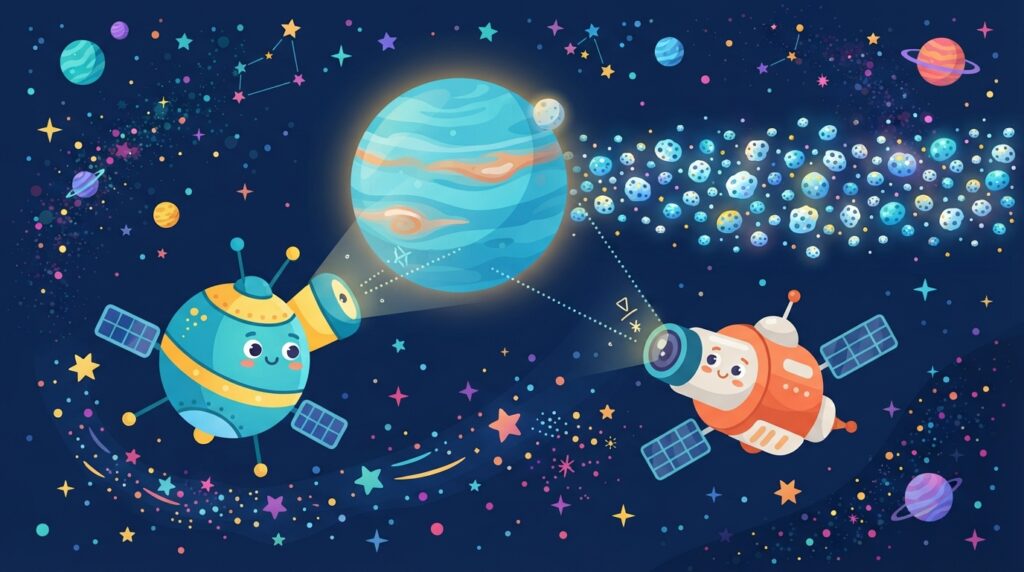
Imagine journeying past the ringed giant Saturn and the deep blue globe of Neptune into the coldest edges of space. On 31 October 2026, scientists announced that they used two famous space observatories to find 27 icy miniature worlds beyond Neptune!
For the very first time, the Hubble Space Telescope and the James Webb Space Telescope worked together on this special cosmic search. These newly spotted objects are floating quietly in the dark backyard of our solar system, billions of kilometres away from our warm homes in India.
What happened?
Two brilliant doctoral researchers, Marielle Eduardo from the University of Victoria and Anastasia Morgan from Northern Arizona University, spearheaded this big hunt. They studied trans-Neptunian objects, which are frozen bodies travelling in orbits further out than Neptune. Findings from the exciting project were presented in two companion scientific papers published in The Astronomical Journal.
Spotting these dim worlds is extremely difficult because they reflect very little sunlight. The James Webb Space Telescope used its sharp Near-Infrared Camera, called NIRCam, to observe a tiny 0.05-square-degree patch of sky across three separate visits. To track the moving bodies, the researchers blended an advanced shift-and-stack imaging technique with an artificial intelligence neural network.
Next, the Hubble Space Telescope dedicated 99 full orbits across nine pointing fields to follow up and measure visible-light colours for 13 of the objects. Combining Hubble’s visible light with Webb’s infrared data allowed astronomers to study wavelengths spanning from 0.35 to 3.2 micrometres.
The smallest of these 27 frozen worlds is only approximately 5 kilometres (3 miles) across! That is five times smaller than the faintest object detectable by the most sensitive telescopes on Earth. Interestingly, astronomers found fewer small bodies than scientific theories had predicted, offering fresh clues that challenge prevailing models of how planets formed. Even better, their surface colours closely mirror much larger trans-Neptunian objects, showing that their ancient materials were preserved for billions of years without being destroyed by collisions.
Why does it matter to you?
When you gaze up at the starry night sky from your terrace or balcony in India, you are looking at a giant history book. These 27 newly found mini-worlds are cosmic time capsules left behind from the very beginning of our solar system more than 4 billion years ago.
By studying these ancient icy relics, young stargazers and scientists can learn how bits of dust and rock originally clumped together to build Earth and the other planets we know today. It proves that combining smart computer programmes with powerful science tools can help us uncover long-lost secrets from the deep past.
Words to know
- Trans-Neptunian object: Any celestial body or icy world in our solar system that orbits the Sun further out than Neptune.
- Neural network: A clever computer programme designed like the human brain to spot faint patterns in mountains of data.
- Wavelength: The distance between peaks of a light wave, which tells scientists whether light is visible, infrared, or ultraviolet.
- Time capsule: A preserved object that keeps ancient information intact for millions or billions of years.
Did you know?
The smallest world spotted in this survey is just 5 kilometres across, meaning you could easily drive from one side of it to the other in a school bus in less than ten minutes!
Think about it
Why do you think it is helpful for astronomers to team up two different space telescopes instead of relying on just one? If you could design a space mission to visit an icy body past Neptune, what kind of instruments would you pack?
Quick quiz
How wide is the smallest newly discovered frozen world beyond Neptune?
- Approximately 5 kilometres
- Approximately 500 kilometres
- Approximately 50 metres
See the answer
Approximately 5 kilometres
Sources
This story was prepared by the Kids Gazette news desk with the help of AI research and writing tools, using the sources listed above.