How Earth’s Invisible Barrier Was Breached in Space
Scientists in Japan discovered how ultra-fast particles supercharged inside Earth's invisible barrier during a mighty solar storm.
High above our heads, our planet has a secret defence system floating quietly in the dark. On 2 November 2026, scientists led by Professor Yoshizumi Miyoshi from Nagoya University in Japan shared an exciting space discovery. They found out how high-speed particles managed to break past an Earth invisible barrier that normally protects our world.
For many years, space researchers believed this invisible boundary was completely impenetrable to dangerous particles. However, detailed recordings gathered by a Japanese space probe called the Arase satellite proved that under the right cosmic conditions, that shield can actually be bypassed from the inside!
What happened?
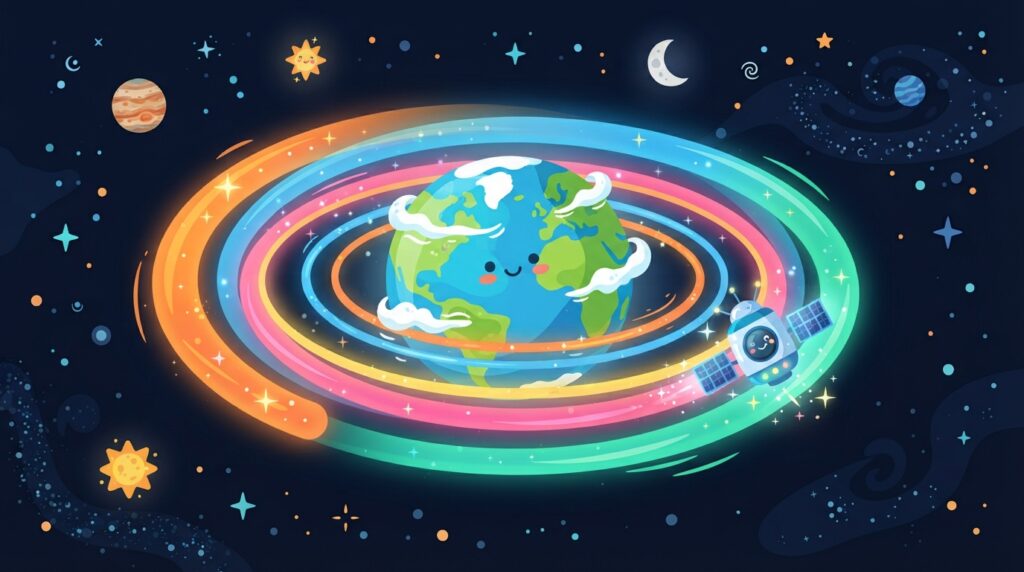
To understand this cosmic puzzle, we need to picture our planet’s neighbourhood. Earth is wrapped inside two giant, doughnut-shaped zones of charged particles called the Van Allen radiation belts. In 2014, NASA’s Van Allen Probes spotted a sharp boundary about 12,000 kilometres from the centre of our world. Because fast-moving electrons rarely crossed this line, scientists nicknamed it an impenetrable barrier.
Everything changed during a historic G5-level geomagnetic superstorm in May 2024. The sun sent powerful waves of energy crashing toward Earth. Japan’s Arase geospace satellite, which has been monitoring these radiation belts since 2017, watched the action unfold. It noticed that ultra-relativistic electrons travelling close to the speed of light suddenly surged into the protected boundary area.
For electrons carrying high energies of around 3 megaelectronvolts, the particle count inside this zone spiked by more than 5,000 times compared to normal levels! At first, scientists wondered if these “killer” electrons had sneaked across the border from deep outer space. But the recorded data told a very different story.
Lower-energy electrons appeared first inside the region. Half a day later, higher-energy electrons arrived, and ultra-high-energy particles peaked roughly one day after that. This step-by-step climb proved that the particles were not slipping past the boundary from outside. Instead, they were being accelerated right inside the barrier zone itself!
The mighty superstorm had temporarily emptied out the plasmasphere, which is a cool, dense layer of gas around our world. With that dense gas drained away, naturally occurring space ripples called chorus waves started buzzing. These electromagnetic waves acted like a cosmic booster pack, supercharging the calm local electrons until they were whizzing at near light-speed. The research team published their exciting findings in the journal Geophysical Research Letters.
Why does it matter to you?
You might wonder why electrons buzzing thousands of kilometres above our school grounds matter to us in India. Every single day, we rely on satellites orbiting high in space for weather reports, watching live cricket matches on television, and helping our parents navigate using digital maps.
When solar storms strike and energetic particles surge, they can damage delicate electronic parts inside spacecraft. Understanding how our protective space belts work helps scientists and engineers design tougher shields for future satellites and keeps brave astronauts safe on future missions into space.
Words to know
- Van Allen belts: two giant doughnut-shaped zones of charged particles trapped by Earth’s magnetic field.
- Geomagnetic storm: a temporary disturbance in Earth’s magnetic surroundings caused by energy from the Sun.
- Plasmasphere: a region of cool, dense gas that circles our planet in upper space.
- Chorus waves: naturally occurring electromagnetic waves in space that can push particles to ultra-high speeds.
Did you know?
The invisible boundary discovered in 2014 sits at a distance of about three Earth radii, which means it is roughly 12,000 kilometres away from the centre of our planet!
Think about it
If you were an engineer designing a satellite to explore deep space, what features would you include to protect it from cosmic storms? How does space weather influence the technology we enjoy every day?
Quick quiz
Which satellite recorded the data showing how energetic particles surged past the barrier?
- The Arase satellite
- The Hubble Space Telescope
- The Chandrayaan lander
See the answer
The Arase satellite
Sources
This story was prepared by the Kids Gazette news desk with the help of AI research and writing tools, using the sources listed above.