Meet PhoneBot: The $400 Robot Run by an Old Phone
Engineers at UCLA have created PhoneBot, a clever two-legged walking robot powered entirely by an everyday smartphone for only $400.
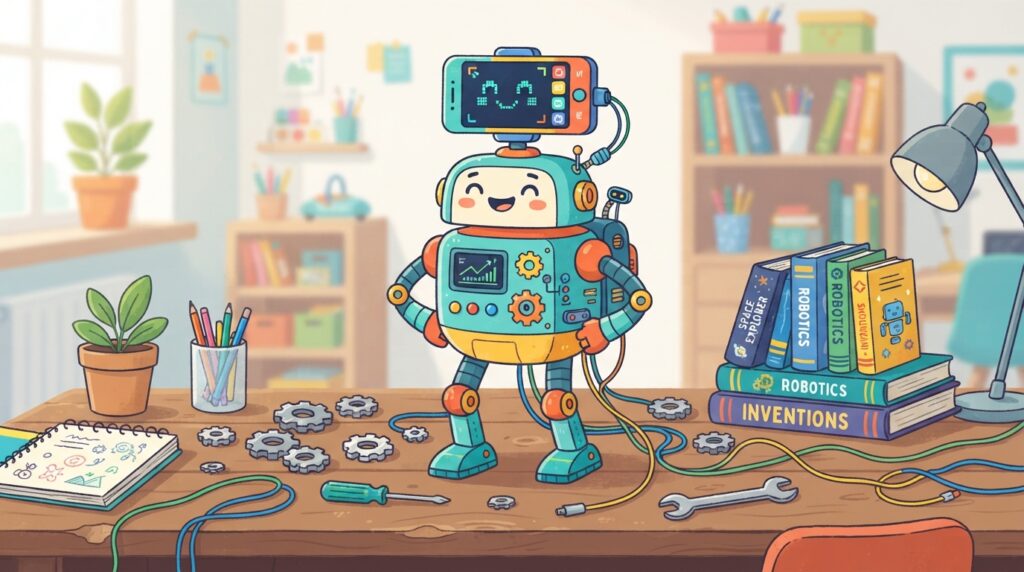
Imagine turning an old mobile handset hidden away in a desk drawer into the brain of a clever walking machine! On 6 November 2026, engineers in Los Angeles, California, showed off PhoneBot, an exciting smartphone humanoid robot that can walk, balance, and spot people.
The creative team at the Robotics and Mechanisms Laboratory at the University of California, Los Angeles, wanted to build a capable walking helper without spending massive amounts of money. Led by Professor Dennis Hong along with researchers Ruochen Hou, Quanyou Wang, and Daniel Koh, the team proved that everyday gadgets can do extraordinary things.
What happened?
PhoneBot is a compact two-legged machine that stands 48.3 centimetres tall and weighs 1.8 kilograms, which includes both its battery and its attached mobile handset. Most small research humanoids are extremely expensive, costing anywhere between $3,500 and $13,800. In contrast, the mechanical and electronic parts needed to assemble PhoneBot cost around $400 without the handset, making it over 85 percent cheaper than existing options!
Instead of relying on a costly specialised computer, PhoneBot uses a mobile phone as its brain and eyes. The robot uses the handset’s built-in Inertial Measurement Unit to keep its balance and its front camera to find and track people. A clever artificial intelligence programme called a neural network runs right on the phone’s processor using TensorFlow Lite, calculating joint movements 50 times every single second.
PhoneBot walks using 13 budget-friendly servo motors. There are six motors packed into each leg, plus a thirteenth motor that swivels the waist so the phone camera can glance around while the feet stay firmly planted. The handset connects completely wire-free over Wi-Fi to a small microcontroller that drives the motors, meaning phones can be swapped out easily.
The researchers trained the walking software in virtual simulations. In tests, PhoneBot walked smoothly, followed human faces, and even stood back up after falling flat on its face! It even runs perfectly on older devices like a 2017 Honor 9 and budget phones priced under $80. The team has shared all CAD files, part lists, and code openly so hobbyists can build their own.
Why does it matter to you?
In many Indian households, older mobile phones often sit unused in cupboards once a family member gets an upgrade. PhoneBot shows that old electronics do not have to become discarded rubbish. With some smart engineering, an old family phone can be recycled and given a brand-new life as a robotic companion.
This breakthrough also proves that students in India do not need giant budgets or fancy laboratories to explore robotics. Because the UCLA team made all their designs open-source, curious school students, coding clubs, and young tinkerers can study the plans and try building low-cost walking machines right at home or in science class.
Words to know
- Bipedal: Having two legs or walking upright on two feet.
- Inertial Measurement Unit (IMU): A small electronic sensor inside phones that detects movement, tilting, and balance.
- Servo motor: A compact motor that can rotate and hold a specific angle very precisely.
- Open-source: Software code or design plans shared freely so anyone can view, build, and improve them.
Did you know?
PhoneBot does not give up when it stumbles; the engineers successfully demonstrated that it can pick itself right back up after falling flat on its face!
Think about it
If you could build a small walking robot powered by an old smartphone, what helpful chores or fun games would you programme it to do around your house?
Quick quiz
How many low-cost servo motors power PhoneBot?
- 8 servo motors
- 13 servo motors
- 24 servo motors
See the answer
13 servo motors
Sources
This story was prepared by the Kids Gazette news desk with the help of AI research and writing tools, using the sources listed above.