Amritsar Students Build Cool Robot Car and Smart Tech
Four young inventors from a government school in Amritsar built a Wi-Fi robot car and a facial-recognition attendance system using basic electronics.
Can four young learners turn basic school supplies into working technological marvels? On 9 November 2026, four talented young inventors from Government Senior Secondary School in Bhangali, Amritsar, proved that anyone can build brilliant machines. This exciting amritsar students robot car project and digital attendance system show how much fun engineering can be for curious young minds.
The creative student team includes four classmates named Gurnaz Kaur, Kushpreet Singh, Harmandeep Singh, and Manjot Preet Singh. Together with helpful guidance from their dedicated schoolteachers, these young innovators built two functional devices right inside their school in Punjab using materials available to them.
What happened?
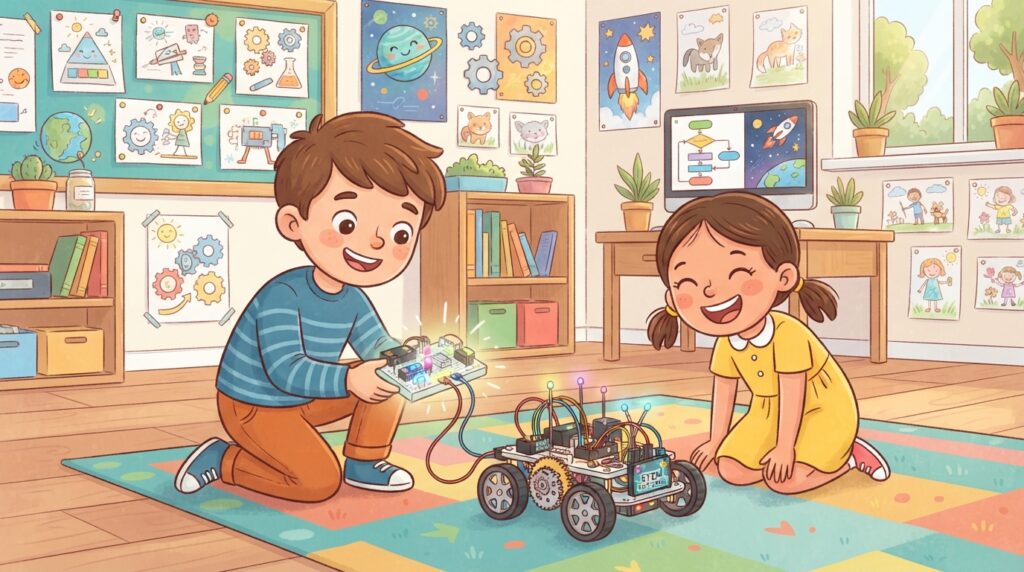
Harmandeep Singh and Manjot Preet Singh collaborated closely to engineer an exciting Wi-Fi-controlled robotic car. They built their prototype car using four DC motors, a special L298N motor driver module, and a portable battery pack to supply power.
At the centre of their car sits an ESP32 microcontroller board, which acts like a tiny electronic brain. This smart board creates its very own local Wi-Fi connection. Because of this wireless signal, the builders do not need to carry a separate remote control to guide the machine.
Instead, anyone operating the car can direct it forward, backward, left, and right using an app or web interface on a mobile phone. The prototype vehicle moves smoothly and has an effective control range of 30 to 50 metres.
At the same time, Gurnaz Kaur and Kushpreet Singh designed and developed a digital facial-recognition attendance system. This project was intended to streamline daily roll calls, making morning attendance much faster and easier for teachers.
The attendance setup uses an attached camera to detect human faces. The system can identify a student within two to three seconds and immediately display the student’s name on a screen.
Once the camera recognizes the student, the system automatically registers the attendance directly into an Excel spreadsheet. It records the name alongside the exact date and timestamp, so no manual paper registers are needed.
Three dedicated schoolteachers, Arvinder Singh, Navjot Singh, and Harvinder Singh, guided the students throughout the planning, construction, and testing of both inventions. Their encouragement helped the students turn everyday electronic parts into working tools.
Both prototypes are scheduled to be showcased at the district-level Digital Innovation Tech Fair on 18 November 2026 at a meritorious school in Amritsar. This exciting fair is organised under the Punjab Education Department’s Mission Raftaar initiative. Visitors will be able to see brilliant projects from 27 schools from across the Amritsar district.
Why does it matter to you?
Many boys and girls imagine that building robots or artificial intelligence software requires a costly laboratory with complex gear. This impressive accomplishment shows that young students can design exciting technology using basic electronics and creative problem-solving.
It serves as an inspiring example that you do not need a fancy laboratory to bring inventive tech ideas to life. With teamwork and curiosity, students anywhere can experiment with circuits and code to solve everyday challenges in their own schools.
Words to know
- Microcontroller: a very small computer on a single chip that can control machines and run simple commands.
- Prototype: an early working model of an invention built to test how well an idea works.
- Facial recognition: technology that uses a camera to look at a face and identify who the person is.
- Timestamp: a digital record that shows the exact hour and minute an event took place.
Did you know?
The upcoming tech fair organised under the Mission Raftaar initiative will feature creative student projects from 27 different schools across the district of Amritsar!
Think about it
If you and your friends had the tools to build a smart robot or computer tool for your classroom, what would you invent? What everyday school task would you like technology to make simpler?
Quick quiz
What is the effective control range of the prototype robotic car?
- 5 to 10 metres
- 30 to 50 metres
- 100 to 150 metres
See the answer
30 to 50 metres
Sources
This story was prepared by the Kids Gazette news desk with the help of AI research and writing tools, using the sources listed above.