
NASA Solves Mystery of the Copycat Supernova Star
Astronomers using NASA's Chandra telescope have uncovered the secret behind a giant star that bursts with light every 113 days.
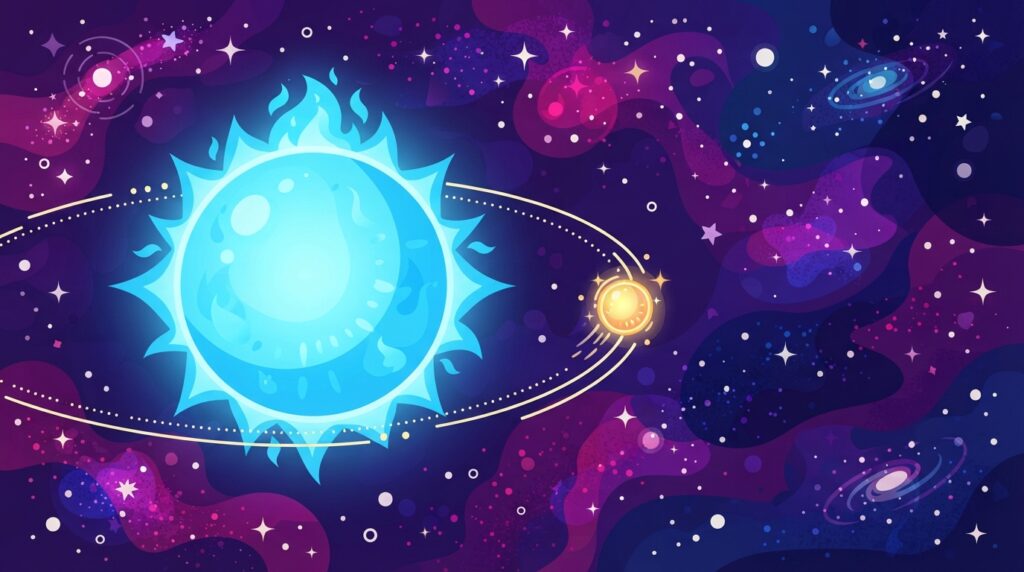
Have you ever seen a grand fireworks show that looks like a giant blast, but leaves everything intact? On 9 November 2026, scientists from NASA and the University of Virginia announced that they solved a cosmic riddle about a supernova impostor star named AT 2016blu. This giant star puts on a dazzling show deep inside the spiral galaxy NGC 4559, which is about 30 million light-years away from Earth.
A massive star normally blows itself to tiny pieces when it explodes as a supernova. However, this curious blue star stayed alive while blasting out brilliant flashes of light over and over again! Led by astronomer Mojgan Aghakhanloo, scientists used NASA’s Chandra X-ray Observatory to find out what was really happening.
What happened?
The star AT 2016blu is enormous, with a mass at least 33 times that of our Sun. It belongs to a rare family called luminous blue variables, which are very hot and unstable stars. Between 2012 and 2026, scientists spotted at least 27 major bursts of optical light from it, like clockwork, roughly every 113 days.
To solve the mystery, professional scientists teamed up with more than 30 amateur stargazers from the American Association of Variable Star Observers and a telescope named KAIT in California. When the star started brightening again in March 2026, the team aimed the Chandra space telescope straight at it. The results, published in The Astrophysical Journal, showed that the star suddenly shone at least 100 times brighter in X-rays than it did in older checks from 2001 and 2002!
The secret is a hidden companion object circling the giant star on an oval-shaped path. Scientists discovered this partner is either a dense neutron star or a stellar-mass black hole. Every 113 days, when this partner makes its closest visit, its powerful gravity rips gas away from the giant star. That gas gets superheated to millions of degrees, releasing a tremendous flash of X-rays!
Why does it matter to you?
This amazing space story shows that you do not need to work at a giant space agency to explore the universe. More than 30 amateur astronomers using backyard telescopes helped make this discovery possible by tracking the star patiently night after night. Whether you look up at the night sky from a balcony in Bengaluru, a rooftop in Jaipur, or a school ground in Kerala, your curiosity can lead to real discoveries!
Words to know
- Supernova: A giant explosion that usually destroys a dying star at the end of its life.
- X-rays: High-energy invisible light that helps space telescopes see extremely hot cosmic events.
- Neutron star: An extremely dense, crushed leftover core of a giant star that collapsed.
- Black hole: A place in space where gravity is so strong that nothing, not even light, can escape.
- Amateur astronomer: A space lover who observes the stars as a hobby rather than as a full-time job.
Did you know?
This is the very first time astronomers have ever detected X-rays from this special kind of erupting star, and the first time one has been found dancing with a black hole or neutron star companion!
Think about it
If you had a telescope at home, what part of the night sky would you want to watch every week? How do you think teamwork helps scientists solve puzzles that no single person could figure out alone?
Quick quiz
How often does the companion object pull gas from the giant star to create a bright burst?
- Every 30 days
- Every 113 days
- Every 365 days
See the answer
Every 113 days
Sources
This story was prepared by the Kids Gazette news desk with the help of AI research and writing tools, using the sources listed above.