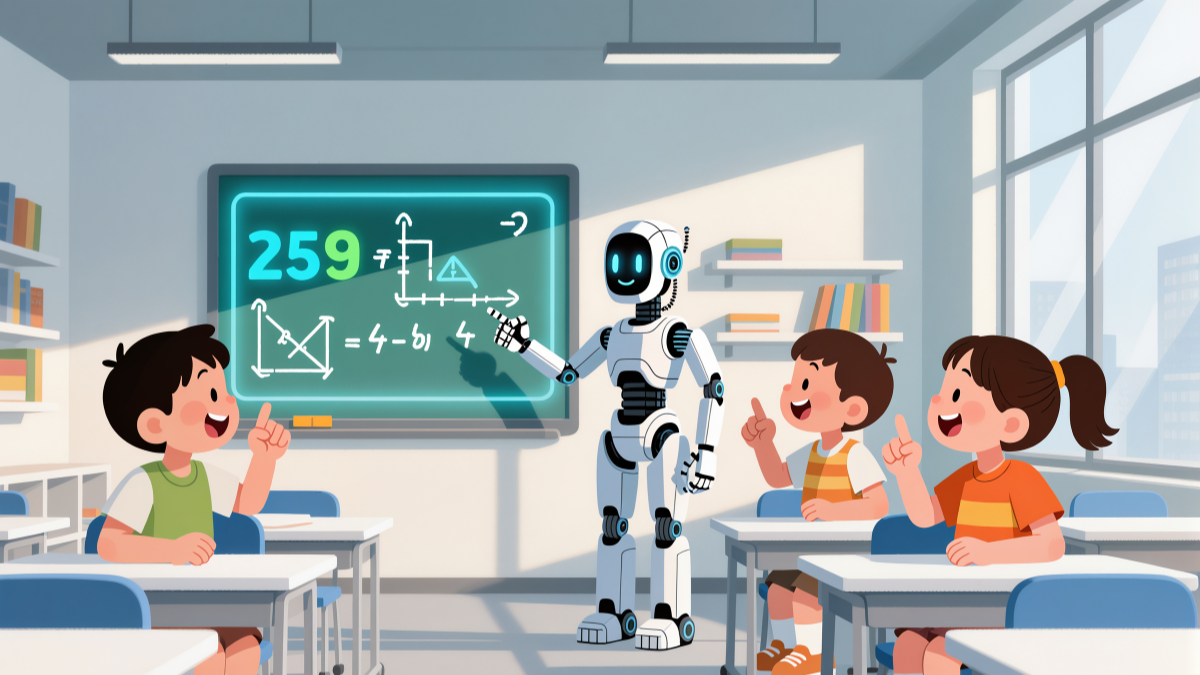
Artificial Intelligence is no longer just a subject in Indian universities — it’s becoming a teacher’s assistant. A recent national survey shows that over 50% of Indian higher education institutes (HEIs) are now using AI tools to create lectures, study notes, and learning resources. The change, driven by both curiosity and necessity, marks a major turning point in how India teaches its next generation.
The survey, conducted by the All India Council for Technical Education (AICTE) and the National Educational Alliance for Technology (NEAT), gathered data from 1,200 universities and colleges across the country. It found that institutions are using AI not only to write content but also to translate study materials, generate quizzes, summarize research papers, and even design interactive classroom modules.
“This is the biggest shift in higher education since the digital classroom,” said Dr. M.P. Sharma, senior AICTE advisor. “AI has become a quiet partner in classrooms — invisible but powerful.”
The rise began during the pandemic, when educators struggled to create large amounts of online content quickly. Tools like ChatGPT, Google Gemini, and OpenAI’s Whisper helped teachers generate summaries, visual aids, and explanations. What started as an emergency solution has now become an everyday habit.
At Delhi University, professors in the Commerce Department use AI to prepare study guides and case studies for management students. “We used to spend days compiling materials from multiple sources,” said Professor Seema Nanda. “Now, AI gives us a strong draft within minutes, and we refine it for accuracy. It saves enormous time.”
Similarly, in IIT Madras, faculty members are testing AI-based simulation tools to help students visualize complex physics and chemical engineering concepts. At Amity University, instructors use AI-driven plagiarism checkers and citation tools to ensure content authenticity.
But while innovation is celebrated, experts are also warning of new challenges — especially in quality control and academic ethics. “AI can generate material fast, but not all of it is accurate or contextually suitable,” said education policy analyst Dr. Rajeev Tandon. “Students must learn to verify, not just copy. AI should assist learning, not replace thinking.”
The University Grants Commission (UGC) recently issued an advisory reminding institutions to ensure that all AI-generated materials are fact-checked, attributed, and original. It emphasized that teachers remain the “final gatekeepers of truth.”
Interestingly, smaller institutions — especially in Tier 2 and Tier 3 cities — are leading the adoption race. Unlike elite universities with large faculty and budgets, these colleges see AI as an affordable way to modernize. “We can now prepare bilingual notes and PowerPoint slides for our students in a day,” said Principal Shilpa Patil of a college in Kolhapur. “AI tools break barriers for students who struggle with English.”
According to the report, nearly 65% of AI-using institutions rely on chat-based models, while 40% use image or video generators for science and engineering content. Around 20% use AI for administrative automation, such as attendance tracking, scheduling, and assessment analytics.
The trend also reflects the growing influence of India’s National Education Policy (NEP) 2020, which promotes technology-driven learning and flexibility in teaching methods. Under NEP, universities are encouraged to blend traditional instruction with digital innovation. The AI revolution seems perfectly aligned with this vision.
At the same time, teachers are rediscovering their roles. “When AI handles routine work, teachers can focus on mentorship,” said Professor Anita George from the University of Kerala. “It’s freeing us to spend more time in discussions and research guidance rather than formatting notes.”
Students, too, have mixed reactions. Some say AI tools help them grasp difficult topics faster. “I use ChatGPT to understand coding errors,” said Rahul Sharma, an engineering student. “But I don’t want it to write my assignments. It should help me think, not think for me.” Others worry that heavy AI use may create over-dependence. “If teachers rely too much on AI, we lose the human touch,” said Divya Menon, a sociology student from Mumbai.
The Ministry of Education has taken note of this duality. A new AI-in-Education Framework, currently under review, will set standards for how AI can be ethically used in classrooms. It will address issues like data privacy, student consent, algorithmic bias, and academic integrity.
Several universities are now establishing AI Literacy Labs — centers that teach both teachers and students how to use and evaluate AI tools responsibly. These labs conduct workshops on prompt writing, citation ethics, and bias detection. “It’s like learning how to drive before you get a car,” explained Dr. Kavita Reddy, who leads one such initiative at Hyderabad University. “AI can empower only when used consciously.”
The global trend supports India’s direction. Universities in the US, UK, and Singapore have also begun integrating AI tools into teaching workflows, often under the label of “augmented education.” A Stanford University study found that when used responsibly, AI-generated content improves comprehension by up to 23% among undergraduate learners. However, it also warned that unsupervised use could reinforce stereotypes or spread inaccuracies.
Some private EdTech companies are already partnering with Indian universities to bridge the gap between policy and practice. Startups like LeaRN.AI, SimplifyEdu, and BharatBot are building localized AI systems that understand Indian languages, cultural contexts, and curricula. “A Hindi-medium student should have equal access to world-class explanations,” said LeaRN.AI co-founder Vivek Joshi. “AI can finally make that possible.”
Still, many educators stress that technology cannot replace empathy. “No algorithm can sense a student’s fear before an exam,” said Professor George. “That’s where human teachers matter most.”
AI also raises questions about authorship. Who owns AI-generated lecture notes — the teacher, the institution, or the software? Legal experts say Indian copyright law does not yet define “machine-assisted creativity.” Until then, colleges are being advised to credit AI tools where used and maintain transparency in public materials.
Despite concerns, momentum is unstoppable. By 2027, analysts expect nearly 80% of Indian colleges to integrate AI into content creation, administration, or personalized tutoring. The government’s AI-for-Education Mission, now in planning, aims to train over 10 lakh educators in responsible AI practices within the next three years.
Perhaps the most striking change is in student engagement. Classrooms once filled with chalk and blackboards now feature screens where students can ask AI-powered bots to explain physics equations or summarize legal judgments in seconds. Teachers guide them to cross-check and discuss results, making learning interactive.
As Dr. Sharma of AICTE summed up, “AI is not replacing teachers — it’s amplifying them. But like every tool, it must be used with wisdom.”
The rise of AI in Indian higher education represents both progress and responsibility. It promises speed, inclusivity, and innovation, but also demands critical thinking, ethics, and empathy. If used well, it can turn India’s universities into true knowledge laboratories — where human creativity meets machine intelligence to build the future of learning.
The revolution has already begun — and it’s happening not in Silicon Valley, but in the classrooms of India.