For thousands of years, people looked up at the stars and wondered what lay beyond the sky. Today, thanks to rockets, humans have explored the Moon, sent spacecraft to distant planets, launched satellites into orbit, and even built space stations where astronauts live and work. Rockets are among the greatest engineering achievements in human history. They have opened the doors to space exploration and continue to help scientists uncover the mysteries of the universe.
A rocket is a vehicle designed to travel through the Earth’s atmosphere and into space. Unlike aeroplanes, which depend on air to fly, rockets carry both fuel and oxygen with them. This allows them to operate even in the vacuum of space, where there is no air. This unique feature makes rockets the only vehicles capable of carrying humans and spacecraft beyond the Earth’s atmosphere.
The basic principle behind a rocket is explained by Sir Isaac Newton’s Third Law of Motion, which states: “For every action, there is an equal and opposite reaction.” When a rocket burns its fuel, it produces hot gases that are pushed out of the engine at very high speed. As these gases move downward, they create an equal force that pushes the rocket upward. This force is called thrust, and it is powerful enough to overcome the Earth’s gravity.
A rocket has several important parts. The engine produces thrust, the fuel tanks store propellants, the payload carries satellites, scientific instruments, or astronauts, and the guidance system ensures the rocket follows the correct path. Modern rockets also have advanced computers that monitor every stage of the journey and make tiny adjustments to keep the rocket on course.
Most space rockets are multi-stage rockets. Instead of carrying one large fuel tank, they are built with two or more stages stacked on top of each other. As each stage uses up its fuel, it separates and falls away, making the rocket lighter. This allows the remaining stages to continue climbing into space more efficiently. Multi-stage rockets make it possible to carry heavy satellites and spacecraft into orbit.
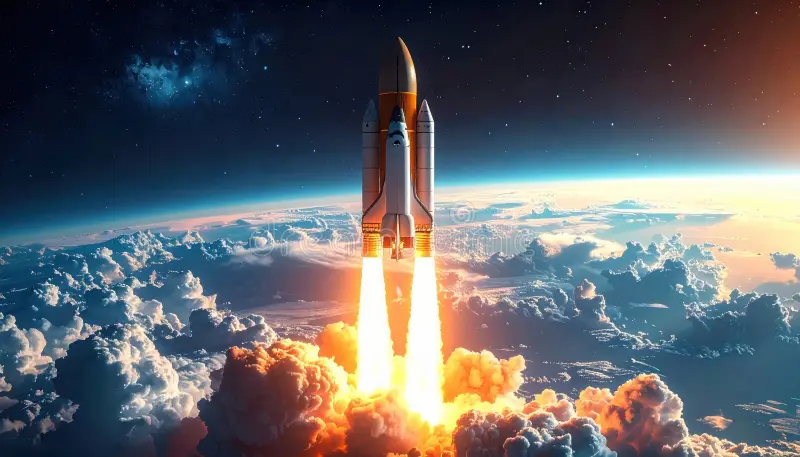
Launching a rocket is a carefully planned event. Scientists, engineers, and technicians spend months or even years preparing for a mission. Before launch, every system is tested repeatedly to ensure it works perfectly. During the countdown, computers monitor thousands of measurements every second. When everything is ready, the engines ignite, producing enormous flames and clouds of smoke as the rocket begins its journey into space.
Rockets have many important uses beyond carrying astronauts. They launch communication satellites that provide television, internet, and mobile phone services. They place weather satellites into orbit to help forecast storms and monitor climate change. Scientific satellites study the Earth, the Sun, and distant galaxies, while navigation satellites make GPS systems possible. Without rockets, many modern technologies that we use every day would not exist.
India has become a global leader in space technology through the remarkable achievements of the Indian Space Research Organisation (ISRO). Indian rockets such as the Polar Satellite Launch Vehicle (PSLV) and the Geosynchronous Satellite Launch Vehicle (GSLV) have successfully launched numerous satellites into space. Missions like Chandrayaan-3, which successfully landed near the Moon’s south pole, and Aditya-L1, India’s first solar mission, have demonstrated the country’s growing expertise in space exploration and inspired millions of students.
The future of rocket technology is even more exciting. Scientists are developing reusable rockets that can return safely to Earth and be launched again. This innovation reduces the cost of space missions and makes space exploration more sustainable. Researchers are also working on rockets that may one day carry humans to Mars and beyond, opening a new chapter in the exploration of our solar system.
Children who dream of working in space exploration can begin by developing a strong foundation in science, mathematics, engineering, and computer programming. Building model rockets, participating in science fairs, joining astronomy clubs, and learning about famous space missions can inspire a lifelong passion for discovery. Future careers in aerospace engineering, astrophysics, robotics, satellite technology, and astronomy offer exciting opportunities to contribute to humanity’s journey into space.
As the famous astronaut Yuri Gagarin, the first human in space, said, “I see Earth! It is so beautiful.” Rockets remind us that human curiosity has no limits. They represent courage, innovation, teamwork, and the determination to explore the unknown. Every rocket launch is a symbol of humanity’s desire to learn more about the universe and our place within it. By encouraging children to dream big, study science, and never stop asking questions, we prepare them to become the explorers, engineers, and scientists who will carry the next generation of space missions farther than ever before. The journey to the stars begins with a single launch—and perhaps with the imagination of a curious child.