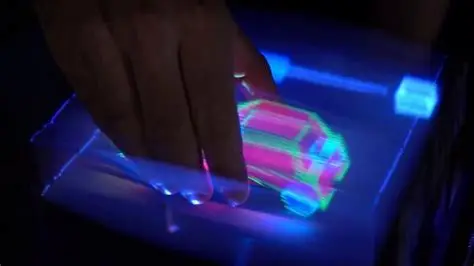
Imagine seeing a life-sized tiger standing in front of you, a famous scientist explaining an experiment, or a model of the Solar System floating in the air—all without any of them actually being there. It may sound like magic, but it is made possible through an incredible technology called holography. Holograms are three-dimensional images created using light, and they are becoming increasingly important in education, medicine, entertainment, security, and scientific research. They show us how science can create realistic images that appear almost real.
A hologram is a three-dimensional image produced by recording and reconstructing light waves. Unlike an ordinary photograph, which captures only the brightness and colour of an object, a hologram also records the way light travels from the object. This allows the image to appear three-dimensional, giving viewers the feeling that the object has depth and can be viewed from different angles.
The science behind holograms was first developed by the Hungarian-British physicist Dennis Gabor in 1947. His groundbreaking work later earned him the Nobel Prize in Physics in 1971. At that time, the technology needed to create high-quality holograms did not yet exist. The invention of the laser in the 1960s made it possible to produce clear and detailed holographic images, leading to rapid advancements in the field.
Holograms are created using laser light, mirrors, lenses, and special recording materials. A laser beam is divided into two parts. One beam shines directly onto a recording surface, while the other reflects off the object being photographed. When these two light beams meet, they create a unique interference pattern that stores the complete light information of the object. When the hologram is later illuminated correctly, the three-dimensional image appears.
Today, holograms are used in many areas of everyday life. One of the most familiar examples can be found on credit cards, passports, driving licences, and currency notes. These small holographic stickers are difficult to copy, helping protect important documents and prevent counterfeiting. They serve as an important security feature used by governments and financial institutions around the world.
Education is another field benefiting from holographic technology. Instead of studying only pictures in textbooks, students can observe three-dimensional models of the human body, planets, historical monuments, or scientific experiments. Imagine learning about the human heart by watching a holographic model that beats and shows blood flowing through its chambers. Such experiences make learning more interactive, exciting, and easier to understand.
In medicine, holograms are helping doctors plan complex surgeries. Three-dimensional holographic images of organs allow surgeons to study a patient’s anatomy before performing an operation. This improves accuracy, reduces risks, and helps doctors explain medical procedures more clearly to patients and their families.
The entertainment industry has also embraced holograms. Concerts, museums, exhibitions, and theme parks use holographic technology to create stunning visual experiences. Some museums display holographic models of ancient artefacts that visitors can observe from every angle without touching the original objects. Filmmakers and event organizers use holograms to create realistic special effects that amaze audiences.
Scientists believe that the future of holography is full of exciting possibilities. Researchers are developing holographic communication systems that may one day allow people to hold life-sized virtual meetings from different parts of the world. Engineers are also exploring holographic displays for vehicles, aircraft, and spacecraft, where important information can appear directly in front of users without requiring traditional screens.
Children interested in science, physics, computer graphics, engineering, or digital design may one day contribute to the development of holographic technology. Careers in optics, laser engineering, medical imaging, computer science, animation, and virtual reality all involve technologies closely related to holography.
As the famous scientist Arthur C. Clarke wisely said, “Any sufficiently advanced technology is indistinguishable from magic.” Holograms remind us that many things that seem magical are actually the result of scientific discovery and human imagination. By encouraging children to explore science, ask questions, and think creatively, we prepare them to become the innovators who will create the next generation of amazing technologies. Every great invention begins with curiosity, and holography is a shining example of how light, knowledge, and creativity can work together to transform the way we see the world.