Imagine a machine that can clean your house, perform a difficult surgery, explore the surface of Mars, or help rescue people after an earthquake. Such machines are called robots. Robots are one of the most exciting inventions of modern science and technology. They are designed to perform tasks that may be difficult, dangerous, repetitive, or impossible for humans. Today, robots are found in factories, hospitals, schools, farms, homes, and even in outer space. Learning about robots helps children understand how science, engineering, and Artificial Intelligence are shaping the future.
A robot is a machine that can carry out tasks automatically or with the help of a computer. Unlike ordinary machines, robots can receive information from sensors, make simple decisions based on programming, and perform actions with great accuracy. Some robots look like humans, while others are designed like vehicles, arms, or small wheeled machines depending on the work they are expected to do.
Every robot has three main parts. The first is the body, which includes the frame, wheels, arms, or legs. The second is the brain, usually a computer or microcontroller that controls its movements and decisions. The third is a set of sensors, which help the robot detect light, sound, temperature, distance, or obstacles. Together, these parts allow a robot to perform its tasks efficiently.
Robots are widely used in manufacturing industries. In car factories, robotic arms weld metal parts, paint vehicles, and assemble components with remarkable speed and precision. Since robots can work continuously without getting tired, they help improve productivity while reducing human effort in repetitive jobs.
Hospitals also use robots in many ways. Surgical robots assist doctors during delicate operations by making highly precise movements. Some hospitals use robots to deliver medicines, transport medical supplies, and disinfect rooms using ultraviolet light. These technologies improve patient care and support healthcare professionals.
In agriculture, robots are helping farmers grow more food. Agricultural robots can plant seeds, remove weeds, monitor crop health, spray fertilizers, and even harvest fruits. Drones and robotic machines equipped with cameras and sensors help farmers identify problems in fields early, leading to healthier crops and better harvests.
Robots are also important in space exploration. Since humans cannot easily survive on distant planets, space agencies send robotic spacecraft and rovers to explore them. NASA’s Mars rovers have travelled across the Martian surface, collecting rock samples, taking photographs, and searching for signs that the planet may once have supported life. These robotic explorers continue to expand our understanding of the universe.
Robots also play a valuable role during natural disasters. Search-and-rescue robots can enter collapsed buildings after earthquakes, explore dangerous areas affected by fires, or inspect locations containing harmful chemicals. By performing these risky tasks, robots help protect the lives of rescue workers while increasing the chances of saving survivors.
Many homes now use simple robots in daily life. Robotic vacuum cleaners automatically clean floors, lawn-mowing robots maintain gardens, and smart home assistants help control lights, fans, and other appliances. As technology continues to improve, household robots are becoming more useful and affordable.
Modern robots often use Artificial Intelligence (AI) to become even smarter. AI allows robots to recognise objects, understand speech, learn from experience, and adapt to new situations. However, robots do not have emotions, creativity, or human judgment. They perform tasks based on the instructions and data provided by humans. Therefore, people will always remain responsible for designing, controlling, and using robots ethically.
Children interested in robotics can begin learning through STEM activities, coding classes, robotics kits, and science competitions. Building simple robots teaches programming, electronics, mechanical engineering, teamwork, and problem-solving skills. These experiences prepare students for future careers in robotics, Artificial Intelligence, computer science, aerospace engineering, biomedical engineering, and automation.
As the famous science fiction writer Isaac Asimov said, “The saddest aspect of life right now is that science gathers knowledge faster than society gathers wisdom.” Robots remind us that technology is most valuable when it is used responsibly to improve human life. They can assist doctors, protect the environment, explore distant planets, and make everyday tasks easier, but they should always serve humanity with safety, ethics, and compassion.
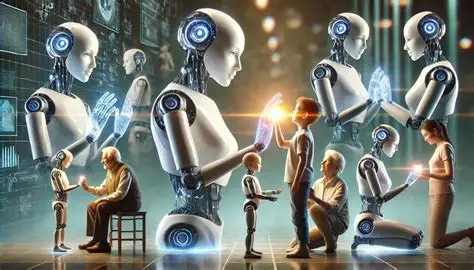
The future of robotics is full of exciting possibilities. Scientists are developing robots that can assist elderly people, help children learn, perform underwater research, clean oceans, and even build structures on the Moon and Mars. By encouraging children to explore science, mathematics, engineering, and programming, we prepare them to become the innovators who will create the next generation of intelligent machines. Every robot begins as an idea, and every great inventor begins as a curious child who dares to ask, “What if?”